L'Anglore - Tavel 2022
We drink a bottle of Tavel Rosé 2022 from L'Anglore.
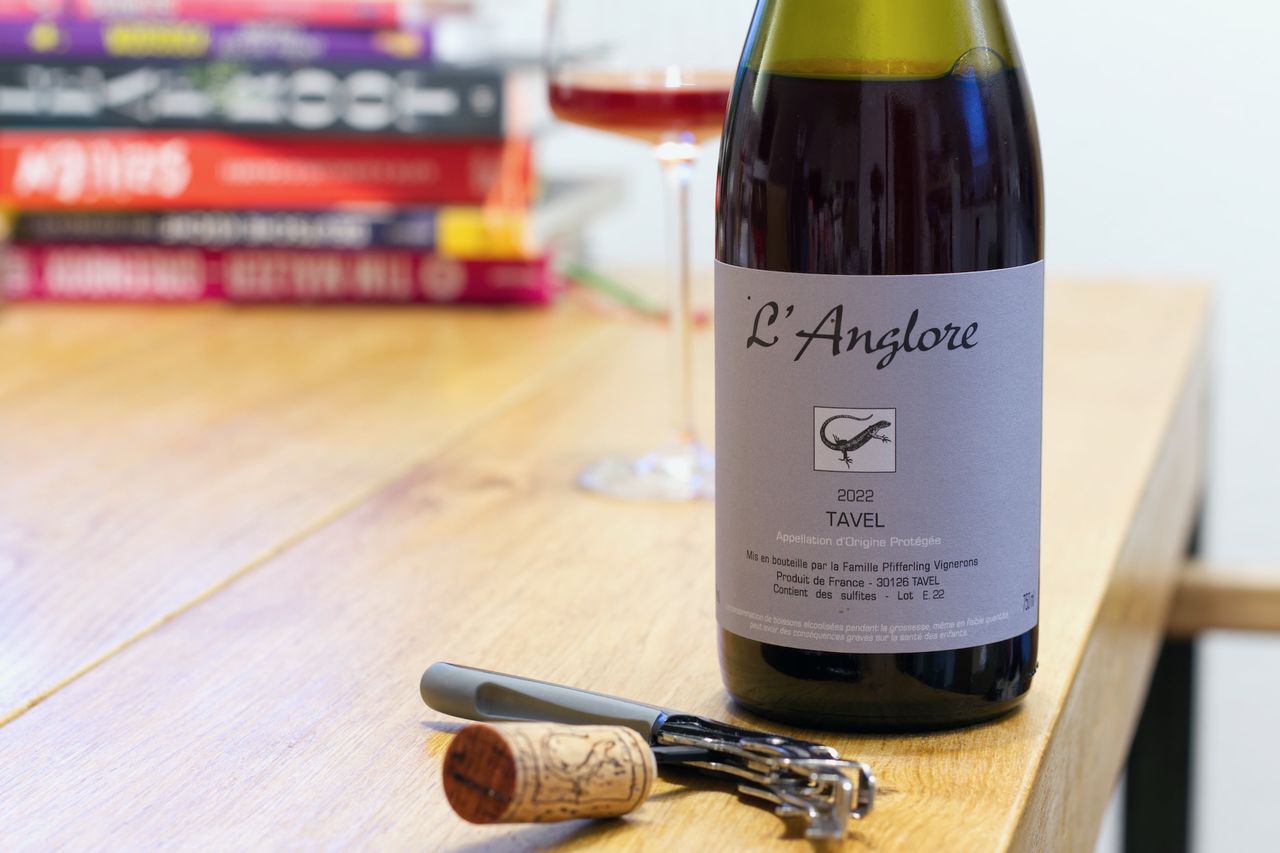
Whenever we’re out and about in another city, we walk into pretty much every wine shop we happen to come across. I simply find wine selections fascinating. The conversations, too. They always start with us pointing out that we’re only having a quick look, because we can’t carry much home anyway and so don’t want to take up any advice, or rather steal any valuable time, especially when there are other customers in the shop. But then they often carry on anyway. We usually just take a bit of deli food or something like that, because wine bottles really don’t make the inevitable platform-change sprint on the train any more pleasant. Sometimes, though, you stumble across a bottle that you end up hauling across the whole country by train in your rolling suitcase anyway. This bottle of L’Anglore Tavel is one of those bottles that made it here from Hamburg. And we had actually only noticed the shop because there were Franzbrötchen and Cannelés de Bordeaux in the window and Jamei cheese from the Allgäu in the counter. And I absolutely needed a Franzbrötchen. But that’s another story.
I have largely escaped the higher-faster-further-better of wine. The FOMO is gone. In both of the directions FOMO goes with wine, that is. The one direction, towards ever bigger wines like great Burgundies, Barolo, Bordeaux and co., was never there in the first place. But the other direction, too, towards tiny bottle counts, hip producers, the hot new shit, has somehow lost its appeal. Fast clicking is practically dead in times of AI tools that support it right in the operating system. And more and more wines are disappearing behind regular-customer walls that we, with our habit of buying a little bit everywhere, never get past. That’s not a criticism, by the way. If it means that more small retailers stay afloat, then that’s fine. And there’s plenty of interesting stuff away from the FOMO, too. And sometimes you still come across a bottle like this. Completely analogue.
Eric Pfifferling inherited four hectares of vineyards in 1988 in Tavel, a small spot in the south-west of the Rhône where only rosé is produced under the AOC. We’ve been here before. It’s now 10 hectares, and the next generation has been on board since 2017. You see the rather plain labels here and there in articles, but in the real world I had never come across them before this visit to Hamburg. And the wines aren’t even that expensive. Just pretty rare. The grape mix is typical of the Rhône, with Grenache, the main share in this bottle, Cinsault, and a little Clairette and Carignan. Farming is organic, the grapes are hand-harvested, fermented in concrete vats and then aged in a mix of barrels and vats. Nothing is filtered or fined. What ends up in the bottle is certainly much closer to red wine than to rosé as you know it. In general, I think unfiltered, dark rosé is the final boss of colour. It would be hard to make a glass look much dirtier than this semi-translucent ochre-red-brown. Anyone who turns up their nose at unfiltered Riesling in the official quality wine testing will probably run away screaming here.
That would be a shame, though. Because even the first time you put your nose in the glass is a joy. There are cherries and cherry sweets, red tea, berries and generally lots of fruit, which never comes across as aggressive or clumsy and shifts slightly every time you smell it. There’s wood and vanilla and blood orange. Fascinating nose. The vanilla makes it onto the tongue, too. There’s amaro, the texture very soft at first, then at the back velvety tannin that slowly creeps further and further towards the middle of the tongue, getting drier and drier as it goes. It’s long, juicy, and what remains in the mouth is again totally reminiscent of blood orange. Sometimes a wine you can’t get your nose out of doesn’t have all that much to offer once you drink it. Not here. Unfortunately, perhaps, because you have to be careful to hold anything back for smelling at all. The way it moves between savoury spice and lots and lots of dark fruit is great. Intense, dense and at the same time light and unfussy. Three hours later it’s still like that. This is not a rosé, it has to be said. This is light red wine. And it’s also a bit wild. For anyone who can’t find anything in that, perhaps too wild. There’s forest floor with cola, homemade iced tea without sugar, wild berry jam and fresh blackberries. The 14% disappears completely in this world.
The real challenge with natural red wine, and with dark rosé too, is the second evening. Countless times, beautiful wines have fallen apart. This isn’t one of them. The colour is even more ochre than on the first day. But the wine is radiant. Cherry, cherry juice, sweetness from the fruit, amaro, bitter orange and red tea. It’s so clear, so juicy, so radiant. Goes perfectly with pizza, is fun on its own. Unfortunately, it was the only bottle on the shelf in Hamburg. Perhaps fortunately, too. That way I don’t have to kick myself for having been too lazy to carry two bottles. I keep saying it: the truly great art is packaging depth effortlessly. Making a nerd wine that doesn’t let on that it sits in the front row right in front of the teacher. And this is one of those wines. I think you can put it down anywhere. Then you explain that the colour is just as it should be, and everyone likes it. And the nerds are happy too. What more could you want.