Two Bottles Kranz
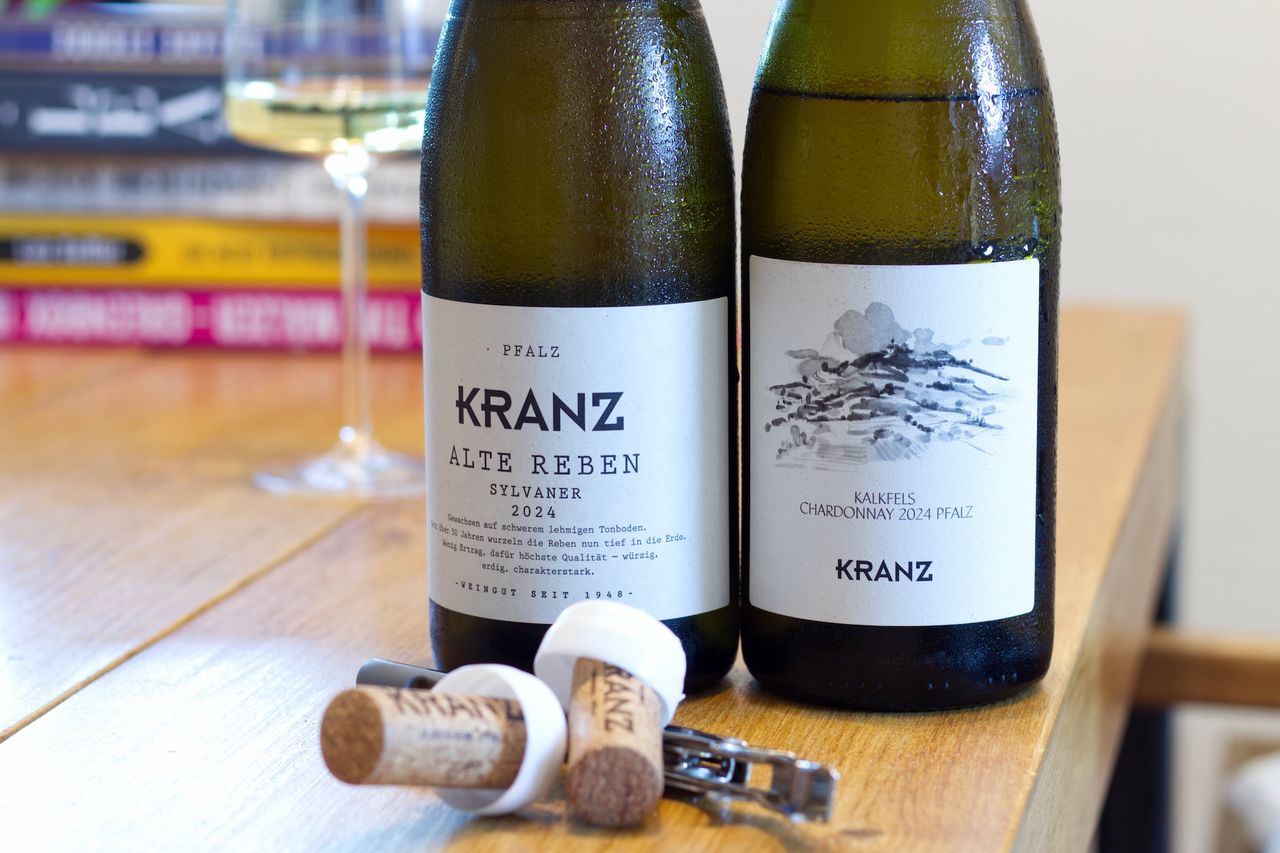
From Weingut Kranz in the Pfalz, we drink a Silvaner Alte Reben 2024 and a Kalkfels Chardonnay from the same year.
Drive out to wineries, they said. Then you connect the wine with an experience, they said. That adds an extra emotional layer, they said. The only extra layer that the visit to Weingut Kranz left behind, however, is the image of a country road. And of the lady in front of us who, in the middle of that very country road, right in a bend, decided that she no longer liked the direction of travel. Who then hit the brakes to turn around in several moves. In the middle of the country road, mind you. It is so firmly lodged in our heads that, at the name Kranz, my better half immediately asks every single time whether those are the ones where, on the way to the winery, someone just turned around on the road like a lunatic. And yes, those are the ones. It’s actually completely crazy that such tiny moments then attach themselves inseparably to something else. There are also wineries where I immediately think that those were the unfriendly ones at trade fair XY, and even if five other fairs have come and gone since then, that never disappears from my head. Maybe I’m the problem there, though.
In any case, we’re drinking Kranz today. We had them here once before with Riesling, what feels like an eternity ago. But as of last week, we’ve played through Riesling for the time being. That’s why there’s Silvaner and Chardonnay, whose corks each came out of the bottle complete with their funny little wax hat. Always fascinating how wax capsules can behave when you pull the cork. The Kranz family makes wine in Ilbesheim in the Pfalz, and the Kleine Kalmit in particular should be known as a vineyard site well beyond the region. And to those who ride folding bikes, Kalmit may ring a bell as well, although the Klapprad-Cup climbs the Große Kalmit near St. Martin, a bit further north. Since our last Kranz, the current generation, in the form of Xaver Kranz, has joined the estate. Both bottles place themselves somewhere in the middle tier of the quality pyramid, with a focus on terroir. The Chardonnay grows on limestone around the Kleine Kalmit, is harvested by hand, pressed directly and then aged in barrel for nine months, half of it new oak. The vines for the Silvaner, more than 50 years old, stand on loamy soils in a single vineyard near Ilbesheim. The wine is aged in stainless steel.
And it’s the Silvaner we start with, pardon, Sylvaner. The older the vines, the more Y, one gets the impression. There’s more structure than fruit, a little hay, and overall it’s rather austere on the nose, rather cool. On the palate, though, the wine pushes onto the tongue with a lot of pressure and gets real power above all from its texture. Hardly any fruit here either, but with this much texture nobody needs it. It really digs its claws into the tongue, and I can imagine that the first sip might be off-putting to one person or another. Me, I like that. And with the wine in the mouth, creaminess and pome fruit come into the nose. That is really strong. Even more so when you factor the price of just under 16 euros into the verdict. A steal. And that sort of thing pleases the inner Swabian, of course. A real surprise for me that a Silvaner like this comes from the Pfalz, because the Pfalz isn’t exactly the German wine region I think of when it comes to Silvaner. If I had to name three regions for German Silvaner, they would probably be Franken, Rheinhessen and Saale-Unstrut. From now on I’ll apparently have to count to four.
And a day later, this is still a really strong Silvaner. Strictly speaking an equally strong Silvaner, because not much has really changed. It remains a wine of structure through and through. Anyone looking for fruit in their wine should reach for a different bottle. But they probably don’t drink Silvaner anyway. And if that sounds exhausting now, it isn’t. You chew around on your tongue a bit, your cheeks pull inward, but then you just drink your way into it. You take a little sip, chew a bit and then drink again. And that’s how the evening passes. And the wine.
The Kalkfels, then, is the contrast program. First of all, the reduction comes flying around your ears. A lot of it, though it perhaps only seems like a really large amount of reduction because the Silvaner had absolutely no reduction at all. There’s a bit of smoke, flint, puffed grain. It’s taut and cool and very tightly packed. It drinks much more openly than it smells, has a lactic note, some yellow fruit, and in some sips it actually recalls fruit yogurt with yellow fruits. There’s length and yet a surprising amount of aroma behind the reduction. A little cassis, tension, depth. It’s good, but compared to the Silvaner it comes across as somehow distant. And that even though the Silvaner is no charmer either. But in its rustic, slightly gruff way, it has something that the Chardonnay is lacking right now. I like the wine on an objective level, but I don’t feel moved.
Here, something does happen overnight. The reduction retreats, not completely, but to a large extent. There’s still oak, a lot of texture on the nose, insofar as you can smell texture at all, or at least imagine that what you’re smelling is texture. There’s citrus in the aroma. My drinking companion is currently going through a lemon phase. Lemon salt, lemon oil, lemon vinegar, lemon this and lemon that. Everything gets lemoned with lemon. And now, too, she comes around the corner and holds a jar of lemon salt in my face. And yes, she has a point. The wine is fairly direct on the palate, rather lean, cool, with more oak than on the nose. It tugs at the tongue, and the texture that announced itself in the aroma then shows up as well. It’s replaced by creaminess at the back, with yellow fruit in between. Where it left me standing yesterday, it picks me up today. I’m always glad that we open this kind of thing at home and not in a restaurant. If the lightning aeration in the decanter doesn’t help at the restaurant, all that remains is a bad memory. At home you can put the bottle in the fridge and try again tomorrow. Or the day after. That is a massive advantage. Or the sommelier only serves what’s ready to drink, in which case that’s moot, of course. In any case, this wine has once again benefited enormously from the night in the fridge. And both Silvaner and Chardonnay are a real joy. Who needs Riesling anyway.