Dönnhoff - Hermannshöhle 2019
From the Dönnhoff winery on the Nahe, we drink a bottle of Riesling Hermannshöhle 2019.
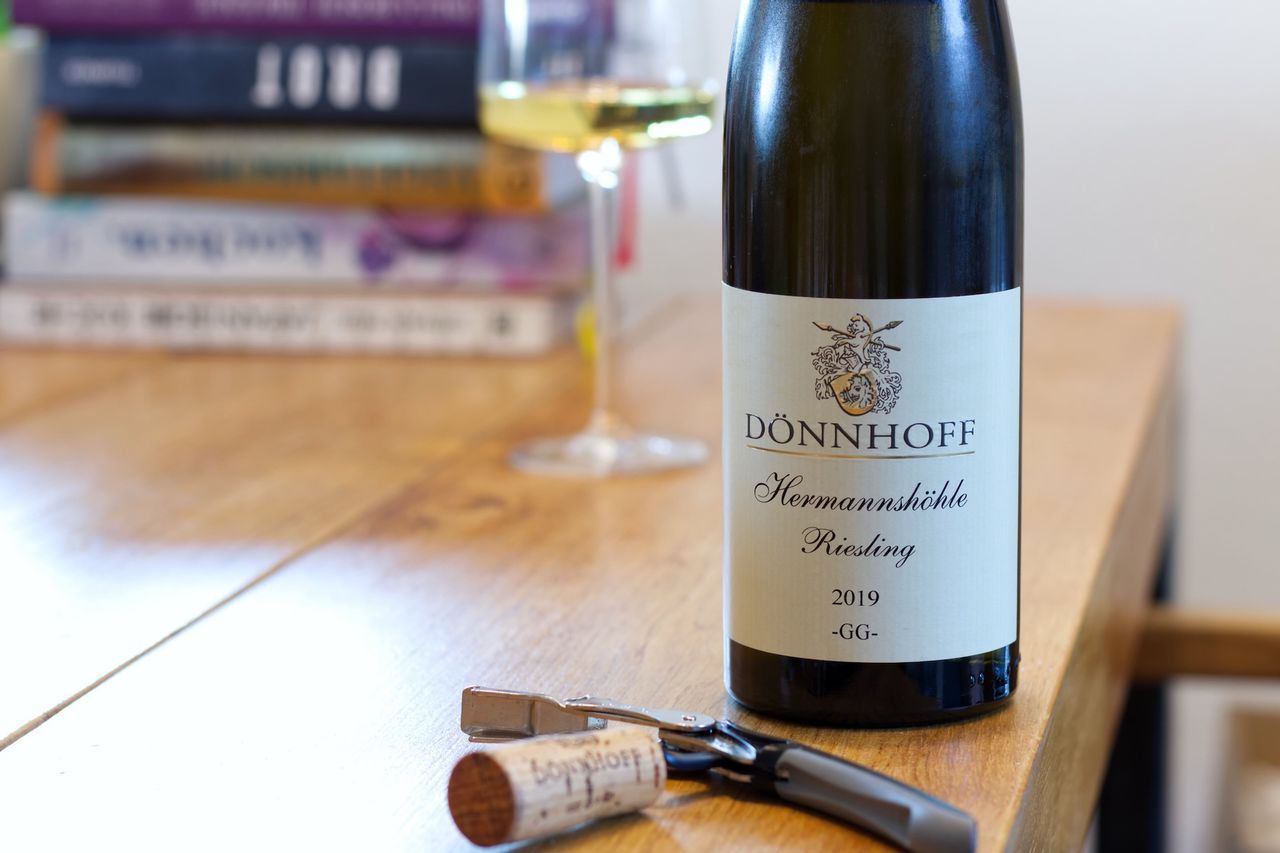
Riesling weeks. And that, here. And unplanned on top of that. But when things are flowing, they’re flowing, and once they’re flowing, I simply let them flow. So Riesling again today. This one comes from the Nahe, one of the regions that show up here relatively rarely. A grand total of five times, says the archive, and the first time was, like today, from Dönnhoff. That one was from the Felsenberg, though, and really, when you say Dönnhoff, you probably often mean Hermannshöhle. The Niederhausener Hermannshöhle to be precise, which, however, is geographically much closer to Oberhausen, the village where the winery is based, than to Niederhausen. As is so often the case in the German wine world. There is an old mine tunnel in the vineyard, hence the name. The vines grow here right on the Nahe on slate and volcanic rock, facing south on the steep slope. They are up to 75 years old. The grapes are picked by hand and the wine is aged in stainless steel and old wood.
The fruit is fantastic from the very first time you put your nose in the glass. Yellow, intense, with lots of citrus and mango. Creamy, with spice and stone behind it. When you swirl, there are cap gun caps in there too, not many, but a few have survived the bottle age. There are herbs, and every sniff brings a slightly different fruit to the surface. Sometimes this fruit is more orange in color, sometimes more yellow. I think to myself that this doesn’t smell like 2019 at all. Nothing right now hints at the years in the cellar. Then again, the piece of tree bark you pull out of the bottle is one of the more stately specimens of tree bark you can pull out of bottles. That has most certainly paid off here.
The acidity is on the darker side. It has drive, but at the same time a balance, a softness, that makes the whole Riesling really charming. And on the palate, too, there is lots of fruit at first. Then, far back on the tongue, it can’t quite hide that bit of maturity after all. A bit of petrol, a bit of the kind of structure that only comes into Riesling with time. This is really good. This slots in right at the very top among the Rieslings we’ve had in the glass this year. This is simply beautiful. So uncomplicated, so harmonious. A wine to lean on, to feel good with. Which is what GG so often isn’t, after all. There is also sweetness on the tongue, which comes either from minimal residual sugar or from the extract. I’m far too taken with it to go looking up analysis figures now. As a GG, it is dry under wine law in any case. We have a red wine open alongside, a tannin monster, and even with the tannin in the mouth the Riesling doesn’t fall apart, it gets almost softer still, even more harmonious with it. Crazy. And for all the gushing and the charm, the wine always has depth. Throughout the whole first evening it stays that way: every sniff smells a little different, every sip tastes a little different. That you can always dive a little deeper. That there is always something more to come.
Astonishingly, almost nothing happens in the first moments on the second day. You have to swirl and slurp, then the wine changes. The more you slurp, the more spice appears. If you simply drink, it turns creamy. There is a bitter note, there is pome fruit and the white pith of citrus fruits. There really is quite a lot of white citrus pith today. I like the structure. It’s different from the first day. More austere, tauter, with more drive and texture. Not better. Not worse. More GG somehow, more resistance. I don’t want to decide. I don’t have to decide either. What I have decided, though, is that this bottle is the best bottle of Riesling I have drunk in 2026 so far. And I’m very sure about that.