Two Bottles of Kissinger
We're drinking a 2022 Riesling and a bottle of 2021 Chardonnay from Moritz Kissinger.
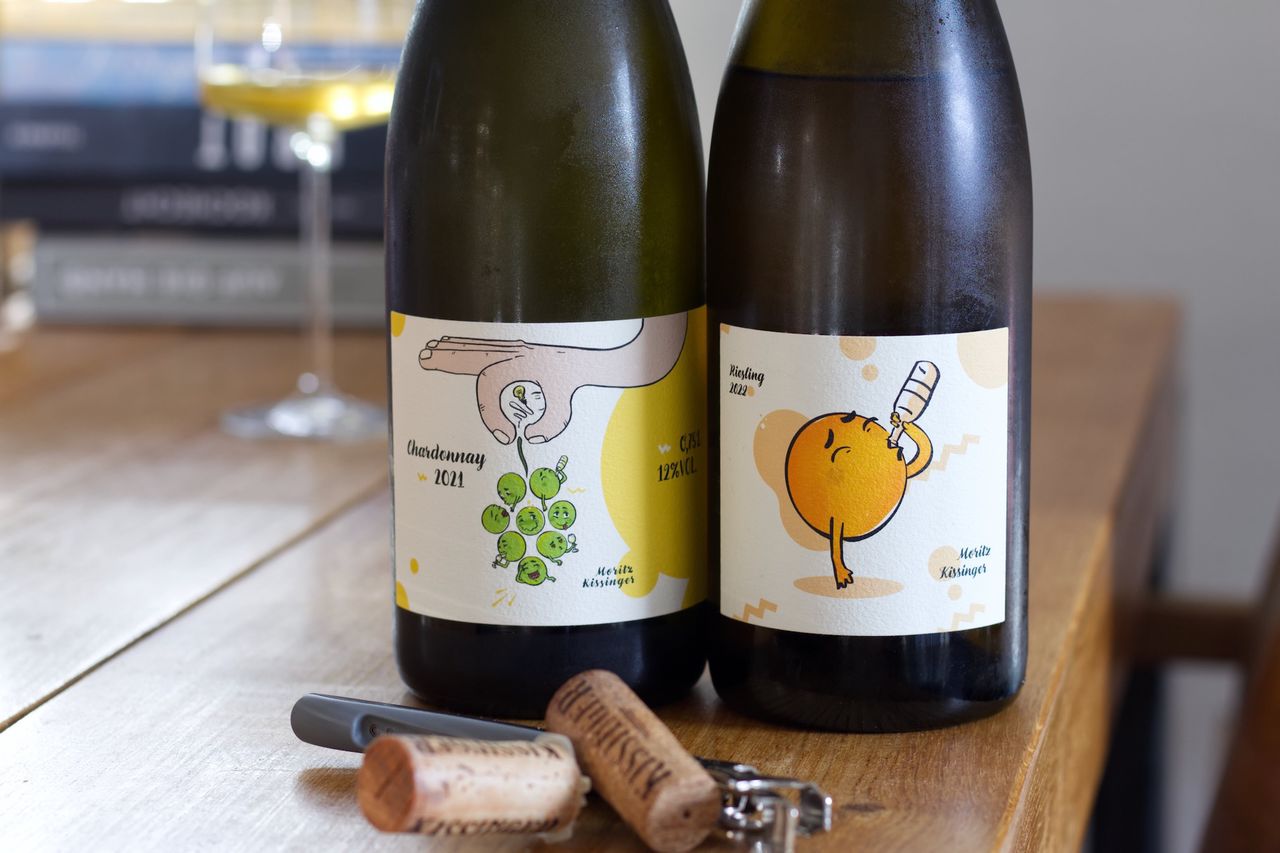
The fact that Moritz Kissinger makes good Chardonnay has probably gotten around by now. And that I like the grapes on the bottles at least as much as the grapes in the bottles should come as no surprise either, after the last few bottles here. One bottle, or rather one wine, is still missing, though: Riesling. At least at the time I bought this bottle, it was still a rarity in Moritz’s range. That’s no longer the case. His partner Jasmin has joined the winery, and under the new name Kissinger-Bähr, a whole lineup of Rieslings from the Rheinfront has been bottled since the 2024 vintage. Pettenthal, Hipping and whatever else they’re called. The funny grapes are still there, but on the new Riesling labels they now only line the edges. Like the wine with its vintages, the people who make it are subject to constant change as well. Wines disappear, wines appear. And I’m sure I’ll taste the new chapter at some point too. Today, though, we’re drinking a bottle from a few pages back. And since you can’t stand on just one bottle, we’re also drinking a Chardonnay from 2021.
Depending on the source, the Riesling grows either in the Dienheimer or the Uelversheimer Talstein on calcareous soil. There isn’t much distance between the two, and even though Moritz makes wine in Uelversheim, the Uelversheimer Talstein is geographically somewhat closer to Dienheim than to Uelversheim. The slope isn’t right on the Rhine, but it still has the river in view. And we passed by here this year too, on the train between Stuttgart and Cologne. It is fermented in stainless steel and then aged in Halbstück casks for 10 months. The 2021 Chardonnay spent 12 months in cask, followed by another half year in stainless steel. Both wines are unfiltered and bottled with a little sulphur.
We start with the Riesling. There’s herbal spice, some apple peel, stone and, apart from a little mealy apple, practically no fruit at all. It’s juicy, and the herbal spice shows up on the palate too. It has a great texture and comes across much brighter when drinking than it smells. Natural-light, somehow. On the one hand squeaky clean, but somehow also with that wild touch natural Riesling has. The longer you keep your nose in the glass, the more creaminess comes in, the more the acidity turns to orange juice. The aroma barely changes, but with air the acidity becomes tauter and tauter. At the same time it feels even a bit clearer, and the wild touch almost completely disappears. We’ve got a fair few bottles of Riesling under our belt by now, but whether a wine like this, sitting somewhere between classic and natural, tips one way or the other, or simply stays put unchanged, I still don’t dare make a prediction. Maybe every bottle of the same wine is even different.
And that’s how the Riesling stays the next day, too. Clear, juicy, somewhat creamy with minimal yellow fruit and lots of herbal spice. If this is the style of wine now being coaxed out of the sites on the Roter Hang, then despite my significantly reduced Riesling consumption, I’ll probably have to stock up. Because this is exactly the kind of Riesling I really enjoy drinking.
As with the Riesling, we pull the cork on the Chardonnay and it goes straight into the glass. Unlike the Riesling, however, the Chardonnay would rather stay in the glass. You really have to swirl vigorously to get any aroma back out. What then comes at you is reminiscent of a mix of multivitamin juice and herb meadow. Behind that sit creaminess and papaya. The acidity seems just as orange as multivitamin juice looks. The softness you think you feel as a result briefly disguises how much power is actually behind it. Acidity and structure carry the wine, they are long, intense, and what remains at the back of the palate lingers there forever. There, at the back of the palate, a bit of maturity appears too. The front of the tongue, however, becomes ever fresher, brighter, crisper and more radiant with air. With air, lactic notes join in, the multivitamin disappears, and the spice takes over together with peach and yoghurt. It seems like a different wine now, and it took just two hours to get there.
It gets nuttier overnight. More the way I would have expected it to be from the start, more the way I had it stored in my memory. But those were other vintages, and my memory deceives me constantly anyway. That’s why I write all this down, after all. Puffed grain, lactic notes, a delicate but very yellow creaminess and exotic fruit. Not-quite-ripe mango, a little butter and structure. This is once again a significantly better Chardonnay than it was on the first evening. Even compared to the end of the first evening. Anyone with no time and only one bottle should probably wait a while longer. Or give it lots and lots of oxygen and hope that has a similar effect to two days in the open bottle. Because now, on the second evening, this is simply beautiful.