Heinrich - Edelgraben 2017
We're drinking a bottle of Blaufränkisch Ried Edelgraben 2017 from Weingut Heinrich in Austria.
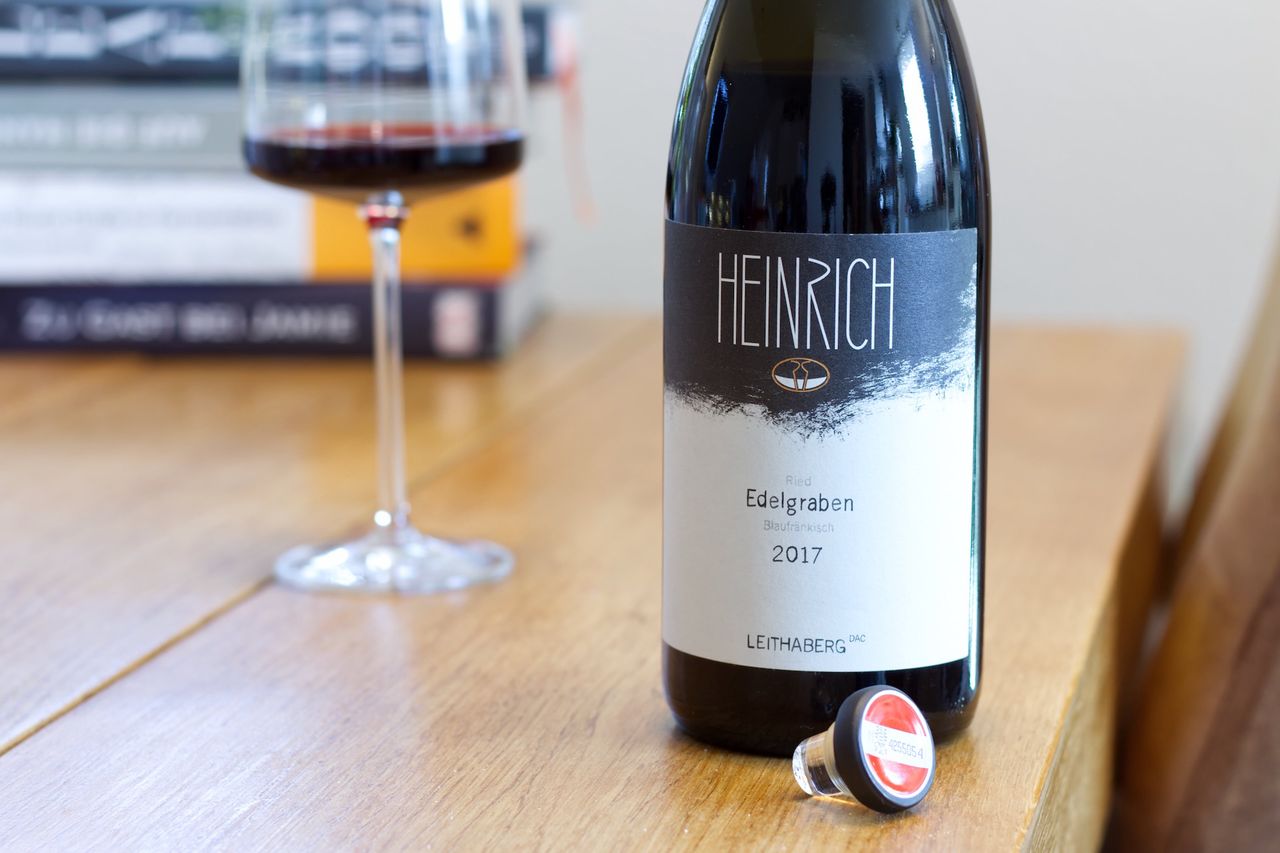
It doesn’t always have to be Lemberger. There’s room for a Blaufränkisch now and then, too. Besides, the last bottle of Heinrich was an eternity ago and, although off the blog we quite often have a Blaufränkisch from Heinrich in the glass, so far only whites have shown up here. That changes now. Funnily enough, we could have drunk this bottle back then, had we actually bought it back then. Because the Blaufränkisch was bottled in April 2020. It grew in the Ried Edelgraben vineyard at the edge of the forest, with a view over Lake Neusiedl, in the Leithaberg region of Burgenland in Austria. To get the winemaking out of the way: the vineyards are farmed biodynamically, the wine is hand-harvested, spontaneously fermented, three weeks of skin contact and then aged in a used 500-litre barrel for close to 30 months. The bottle is sealed with a glass stopper, which personally always makes me very happy. Under that glass stopper the Lemberger, pardon me, Blaufränkisch, has now had almost another seven years to relax. It can spend that time in the winery too, since the vintage is still available directly from the estate.
When the grapes on the vine really squint their eyes and gaze out across Lake Neusiedl, they might just catch sight of the winery. That’s because it sits in Gols, east of the lake, closer to the Hungarian border. If you look at the map of the sites farmed by the Heinrich family, they curve like an amphitheatre around the northern tip of Lake Neusiedl. To the west the Leitha Mountains, to the east rather flat sites, water in between. It would actually be rather exciting to taste those directly against one another. A project for another time.
The fruit is dark and somehow slightly vegetal. I’m cautious about saying “vegetal”, because it immediately gets shoved into the negative potato-soup corner. But that’s not what this is. It’s simply savoury, without being negative in any way. There’s cherry, there’s herby spice, and what was vegetal now reminds me more of game spice with prunes. The more you swirl, the livelier it gets in the glass. The acidity picks up more and more drive, this is juicy, almost fruit-juicy with all those cherries, and has plenty of depth. With the wine in your mouth a little sweet pastry joins in on the nose, and the more you swirl the more the spices move towards cinnamon and company. This is a real joy and, while on the nose you still think you can smell the 9 years it has on its back, you taste none of it. It’s simply so fresh, there’s zero age, zero maturity to it. Red berries, cassis, cherry and so much freshness. You could also just guzzle it down in big gulps without thinking too much. You could. But you don’t have to.
It gets darker still on the second evening, a touch woodier, drier, not the absence of sugar, it’s so thoroughly fermented that there’s nothing left there anyway, but in the sense of not being wet. I like the fruit, the slightly dried quality within it, the complexity. But the fruit also takes a step back. It’s quieter today, more measured. At least on the nose it is, because on the palate the Edelgraben doesn’t differ one bit from the previous day. You start to smell the bottle age more and more, taste it you still don’t. This tightrope walk between nerd wine, which for around 50 euros it undoubtedly is, and an uncomplicated red you can basically pour for anyone, this bottle pulls off with flying colours. The more you drink, the fuller it becomes again, the more intense, the more fruit and structure linger on the palate. That’s really lovely.