Two Bottles Philipp Reiß
We drink an orchard-fruit cuvée from 2024 and a Chardonnay from 2022, both by Philipp Reiß from Baden.
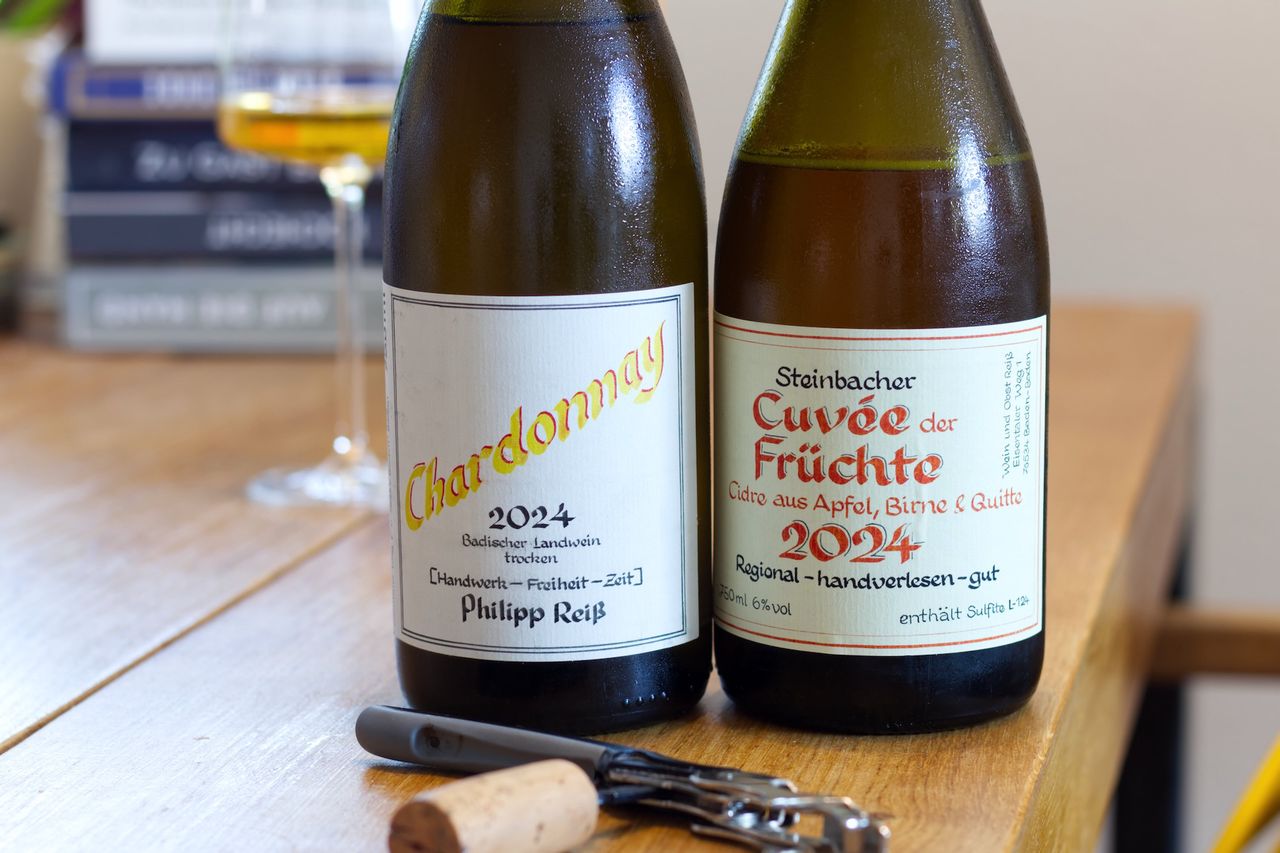
We first crossed paths with Philipp in Karlsruhe. And in this case “crossed paths” is meant quite literally, because Philipp, like us, was a guest at the very first round of Schmelz, Perlage & Bodensatz. Unlike us, though, Philipp had brought a few of his own wines along. The guest on that first evening in 2022 was Christoph Raffelt. And maybe that was exactly where Christoph got to know Philipp’s wines, too. I don’t know, but I’ll know soon, because, and here the circle closes, the next round of WRINT is all about Philipp Reiß’s fermented orchard fruit. Full circle moment. That, at any rate, is how these two bottles ended up with us, because somehow you have to heave those parcels over the free-shipping threshold. And, spoiler, the Chardonnay is so good that it’s now showing up here. On top of that, over the next two weeks there will once again be apples, pears and quinces to read about in this spot, so a half-wine-half-orchard-fruit post makes the perfect segue.
Philipp makes wine in and around Steinbach, between Baden-Baden and Bühl in the Ortenau in Baden. The family has been growing wine here for four generations, and the traditional orchards in Steinbach are part of the estate too. As is so often the case, though, it is Philipp, in the current generation, who is starting to raise the wine entirely himself. Grandpa’s cellar helps with the ageing, Grandpa’s steady hand with the calligraphy on the labels. For the Cuvée der Früchte, pears, apples and quinces are spontaneously fermented, made sparkling in the Palatinate, and then sweetened with a little fruit-juice concentrate and stabilised with minimal sulfur. The Chardonnay grows on young vines that were planted only a few years ago. Philipp’s first single-varietal Chardonnay. The plant material comes from Burgundy, the grapes spend a short time on the skins and are then aged on the full lees for just under a year in new, small wooden barrels.
The cider is bottled under screwcap. And as much as I like a screwcap on wine, it feels odd on a sparkler. Not because I don’t like the screwcap as such, quite the opposite, but with fizz, at least in my head, only the bottom-shelf stuff you have to bend down for gets a screwcap. Maybe here, too, it is time to rethink that. Being able to put the half-full bottle back in the fridge, resealed, definitely has its advantages.
This smells of rather mealy apple, a bit of pear and, at least at first on the nose, practically no quince. You really have to breathe in for a long while before a little quince jelly emerges from behind the apple. Along with a few bits of marzipan. On the palate, though, the quince is there. Not so much bathwater quince, which I like too, but really quince jelly. The acidity tiptoes somewhere along the ridge between “I like it” and “I’m scared of it”, because at least at the back of the palate there is real punch behind it. With the cider on the tongue, the quince then shows up more clearly on the nose as well. Like that a lot. With more air the fruits keep taking turns. Apple and pear, mind you, are hard for me to tell apart in a blend like this anyway. Quince is different: when it’s there, you smell it. You have to like it. I like it.
The first thing we notice about the Chardonnay is how clean it is. We had Philipp’s rosé in the glass a few weeks ago, and that one landed decidedly on the wild side of the wine spectrum. And what we tasted back then in Karlsruhe, too, I would file, going by my memory, pretty much all of it in the natural-wine drawer. Not the Chardonnay. It is nutty, you notice the new oak, but it doesn’t get in the way, there are yellow fruits and puffed grain on the nose. That is really impressive, and then the mouthfeel. Somewhere between creaminess and spice, elegant, fresh and spotless. It is long, it tugs at the tongue, it is juicy, it has spice, depth. You would have to stretch quite a bit to find something similarly good for the 21 euros being asked here.
Day two is practically unchanged. Clear as a bell, spicy, radiant, puffed grain, a touch of reduction and vanilla. The vanilla, which wasn’t there yet on the first evening, only appears when you swirl the glass. I like the structure, I like how it drinks. A real surprise, this wine, and a more pinpoint result for a debut Chardonnay would surely be hard to manage. If the coming vintages turn out like this too, then you’ll simply have to have these wines on your list.