Two Bottles of Chanterêves
From Burgundy we drink a bottle of Aligoté Bas de Ees 2022 and a bottle of Pinot Paris l'Hôpital 2022 by Chanterêves.
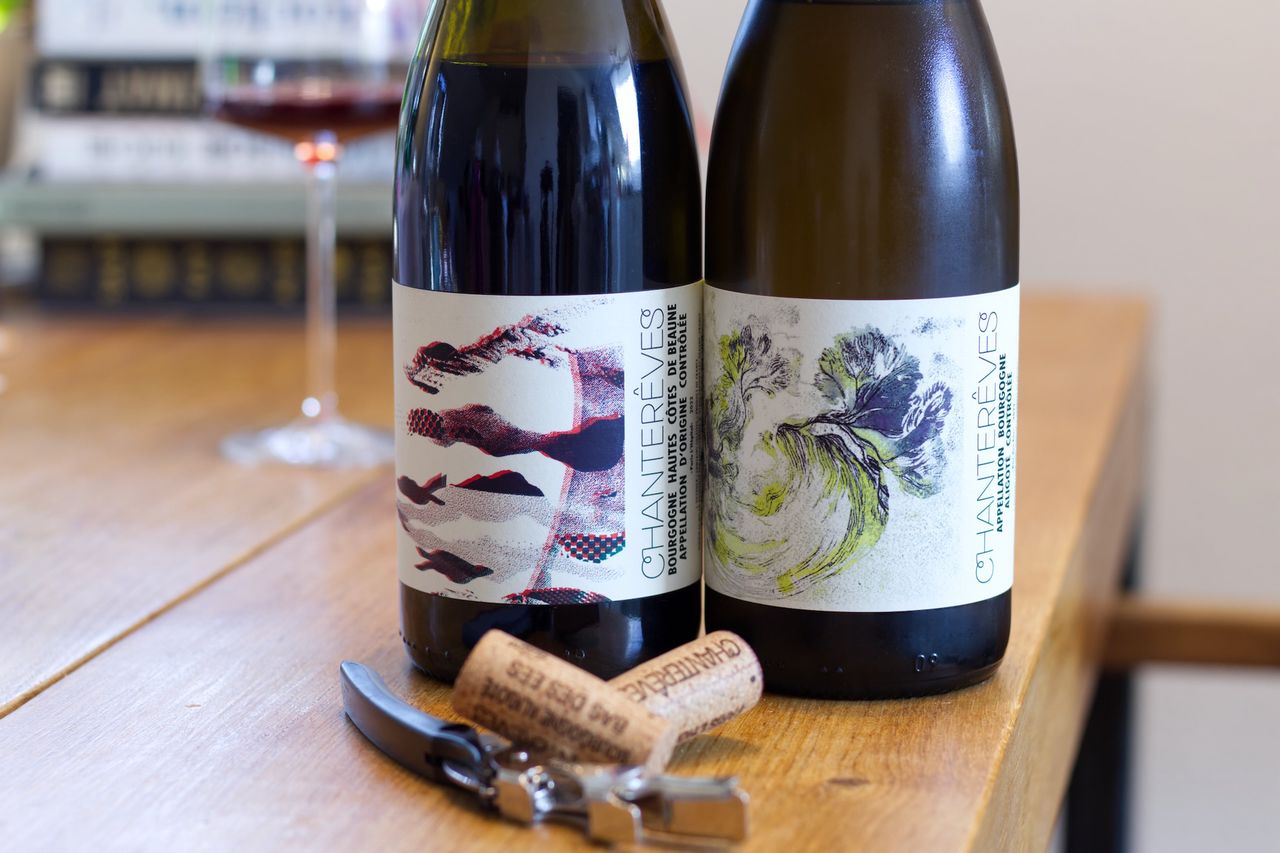
With the last bottle I mentioned that the labels look different now. And that, personally, I somehow prefer the old ones. I’ll stand by that. But the contents, I found them so good that what’s stuck on the bottle really doesn’t matter much to me. Funny in hindsight that, of all bottles, it was this one where the dog teapot took a seat in the background. Because with that one it’s 100 percent looks and 0 percent substance. Not just because it’s empty in the picture, but much more because it doesn’t work as a teapot at all. The handle gets hellishly hot and the spout drips. I’m digressing.
Chanterêves is still Tomoko Kuriyama and Guillaume Bott, who make wine in Savigny-les-Beaune. What they work with is still a mix of their own grapes and bought-in fruit. In 2020 the two of them were able to buy vineyards, among which is a parcel planted with Aligoté. Whether this Aligoté comes from one of those vineyards I unfortunately couldn’t find out, and since there are a full five different Aligotés in the portfolio, the possibilities are many. But on the vinification you can find something: the grapes grow near Marey-les-Fussey at around 470 metres. They are slowly pressed, fermented with wild yeasts and then aged for about a year in small wooden barrels, before going into a stainless steel tank on the fine lees for another half year. Only minimal sulphur is used. The Paris-l’Hôpital is fermented with whole clusters, like almost all the reds at Chanterêves. It, too, is fermented with wild yeasts, pumped over by hand daily with buckets, and then a similar procedure to the Aligoté: a year in used oak, half a year in steel on the fine lees, minimal sulphur.
There’s a fine savouriness in the Aligoté, a bit of stone, a few grains of puffed cereal. And it tastes exactly the way it smells. Clear it is, very clear, it really shines. Savouriness in the middle of the tongue, salt, a pull at the edges, a little citrus fruit and something exotic in the acidity. Juicy with real zing behind it. Somehow the perfect summer wine. And at the same time with so much depth and radiance that you briefly wonder why Aligoté flies so far under the radar and simply gets overlooked as a drinking-fun grenade. Which is a reference that was already far fetched for the local audience, internationally it probably is totally lost. Let’s leave that. With the wine in the mouth it turns nuttier on the nose and, despite the linearity on the palate, there really is depth. Air does it good too. A little buttermilk, less nuttiness, comes across smoother now. You could ponder over it. But you don’t have to in order to have fun with it.
Not a great deal happens overnight. On the nose, at least. On the palate, structure and a lactic character now dominate, with a lovely, salty savouriness. It’s again more citrus than exotic and really astonishingly structured. With every slurp there’s more of it. Pretty brilliant.
What a wonderful fruit the Pinot has, then. That’s actually what stuck with me from the Les Tuyaux too: a really, really lovely fruit. And like the Aligoté before it, this wine shines as well. It’s so clear, in every single component. There are cherries, black and red berries and an ethereal lift. On the palate lots of cherry juice, then a hint of tannin, only in the middle of the tongue, a touch of forest floor, smoke and a spiced savouriness. It’s simply beautiful and I like it a lot. Even with the new label.
Where with the Aligoté time stands still overnight, the Pinot changes noticeably. It becomes even fruitier with lots of wild berry, slightly bruised, but neither brown nor overripe. It comes across sweet on the nose now, in the fruit that is, no one will have tipped any sugar in there, and you can’t smell sugar anyway. At first I think the tannin has completely disappeared, but it only takes about two or three sips to be back again. Softer it has become in any case. That this has only 11.5 percent is then somehow the cherry on the cream cake. Another one of those wines for the summer. Really, though, for any time. The spices come back with more air. And there’s a note of green currant bush there too. It fits in perfectly. This is a feel-good wine. A bit like the Aligoté already, only more of it. Even more charming and, at the same time, even deeper, should you want to dig for it.