Three Bottles Markenhof
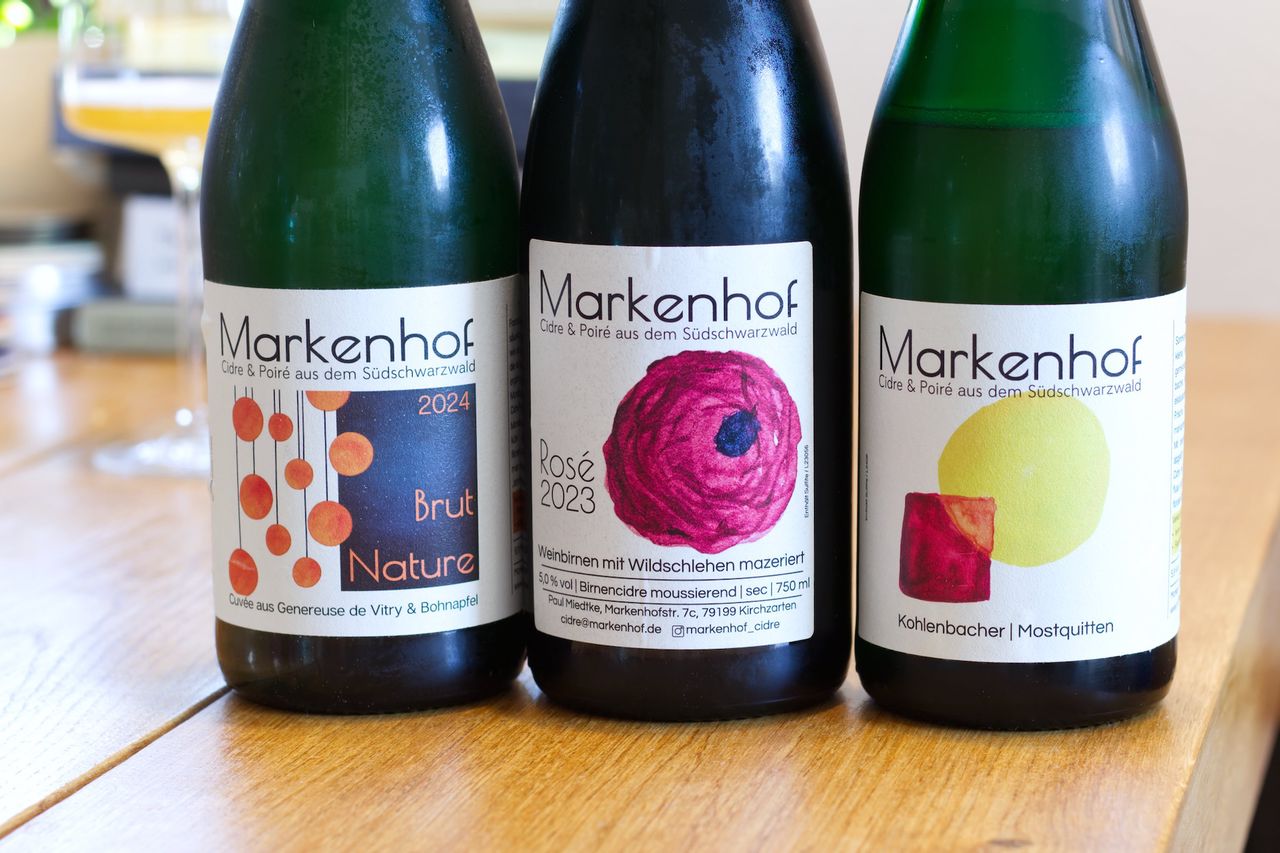
We drink a Brut Nature 2024, a Rosé 2023 and a Kohlenbacher with cider quinces from Markenhof in Baden, all fermented traditional orchard fruit.
Sometimes there’s a worm in it. In the apple, of course, but sometimes in the parcel shipping too. What was no longer in it was a good third of the bottle’s contents. Astonishingly, though, it had made its escape into the box without taking the crown cap on the bottle with it. And luckily also without dragging the bottle down into the abyss along with it. At least in the box that made it to us. The second box didn’t get nearly that far. But it’s been nearly two years now since the last broken glass. Still a pretty good rate, I’d say. Paul then packed the replacement shipment with so much padding that you could probably have thrown it out of a moving car without anything happening. Paul makes cidre at Markenhof in Kirchzarten, near Freiburg. So near Freiburg that, without knowing it, a few years ago we cycled almost right past his farm gate on our folding bikes during our annual Freiburg holiday. Lovely there along the Dreisam, at least when the Dreisam has water, which sadly is in short supply at the moment.
I don’t even know whether we’d have been able to get any cidre back then, because Paul himself only started getting to grips with cidre five years ago, after a holiday in Normandy. The first attempts were hard going, but an old Swabian university friend, Urs Renninger, who has turned up here before too, was happy to pass on his knowledge. Swabian–Baden entente in practice. Almost like here at our own dinner table. By now they press a considerable range at Markenhof, dry, with residual sugar, from apple, pear, quince and other fruit. We drink three bottles: Brut Nature 2024 from Genereuse de Vitry, an old French variety that above all brings tannin, and Bohnapfel, a traditional German variety that brings acidity into play. Rosé 2023, pressed from perry pears and wild-gathered sloes from the Black Forest. And a cuvée from the apple variety Kohlenbacher, a local variety that in 2021 was even named Traditional Orchard Fruit of the Year, and quince.
Quince is what comes to mind immediately when you pour, anyway. The way it foams in the glass is quite distinctive. A lot of rather dense, very white foam that collapses again as fast as it appeared: quince. And yet at first you smell more apple than quince. It also reminds me a little of poached pear, the kind you hope to find on a roast of venison. And yet there’s no pear at all in the glass. The quince keeps dropping by every now and then, and maybe that’s exactly why I find quince so exciting. You can do so much with it. Quince full in the face, quince in the background, bathwater, quince jelly. A thousand variations, and all of them can be great. This one is great. On the palate then clearly more quince than on the nose, the acidity recalls green apples, there’s structure and a bit of sweetness. If you need the quince punch, just stick your nose in the glass right after pouring. That’s where the quince delivers.
That also works wonderfully with pasta with slowly braised soffritto and a few fresh cherry tomatoes briefly braised along with it. The cidre turns distinctly sweeter alongside it, which makes a terrific combination with the oil and butter and the vegetables.
The Rosé, like a cider last week, doesn’t seem especially fond of its existence in the bottle. I don’t get it at all, because the labels are great. I’m caught unprepared, because the crown cap only hisses quietly and then, for three seconds, just as quietly, foams very steadily up out of the bottle. My better half comes running and saves the situation. Hardly any losses to mourn.
With sloe I actually expect marzipan, which is probably down to the sloe eau-de-vie on the shelf behind me. But this smells of a mixture of rhubarb, elderflower and pear. Behind that comes a hint of what, once distilled, will turn into marzipan. It has drive, astonishingly much drive, in fact. It’s juicy, rather taut, and pulls more on the palate than on the tongue. The more you drink, the more complex the fruit becomes: berryish, spicy, a little herbal, and forest honey. Unfortunately you also notice the sweetness more with every sip. I’d be curious how it would be bone dry, because one glass of it is enough for me, at least. But I can imagine this easily finding plenty of fans.
Brut Nature is then, of course, the most brutal possible contrast programme, and that’s exactly why we drink it now. Taut, with lots of apple on the nose, really fresh apple straight from the tree, and slightly browned apple peel are there. Clear, pure fruit that only really emerges when you hold your nose in the glass for longer. Maybe it’s a touch too cold, straight out of the bottom shelf of the fridge like this. But these days the too-cold problem sorts itself out faster than you’d like. I like the tannin that Genereuse de Vitry brings into the glass. It’s long, taut, almost a little austere on the tongue, in a thoroughly pleasant way. And unlike with the perry pear, here I could finish the whole bottle without ever getting my fill of it. That said, I don’t even want to claim I like this one more. The sloe is great, but the sugar tires me out quickly, at least. And this one, you can drink it sip after sip after sip and never want to stop. It’s all good, but the Brut Nature is a little betterer. And I also understand if this is too austere, too puristic, too tannic for you. But then I’m afraid you just don’t have a clue. And as already said, a cidre like this is the perfect answer to summer anyway.