Domaine Labet - En Chalasse 2016
We're drinking a bottle of En Chalasse Chardonnay 2016 from Domaine Labet in the Jura.
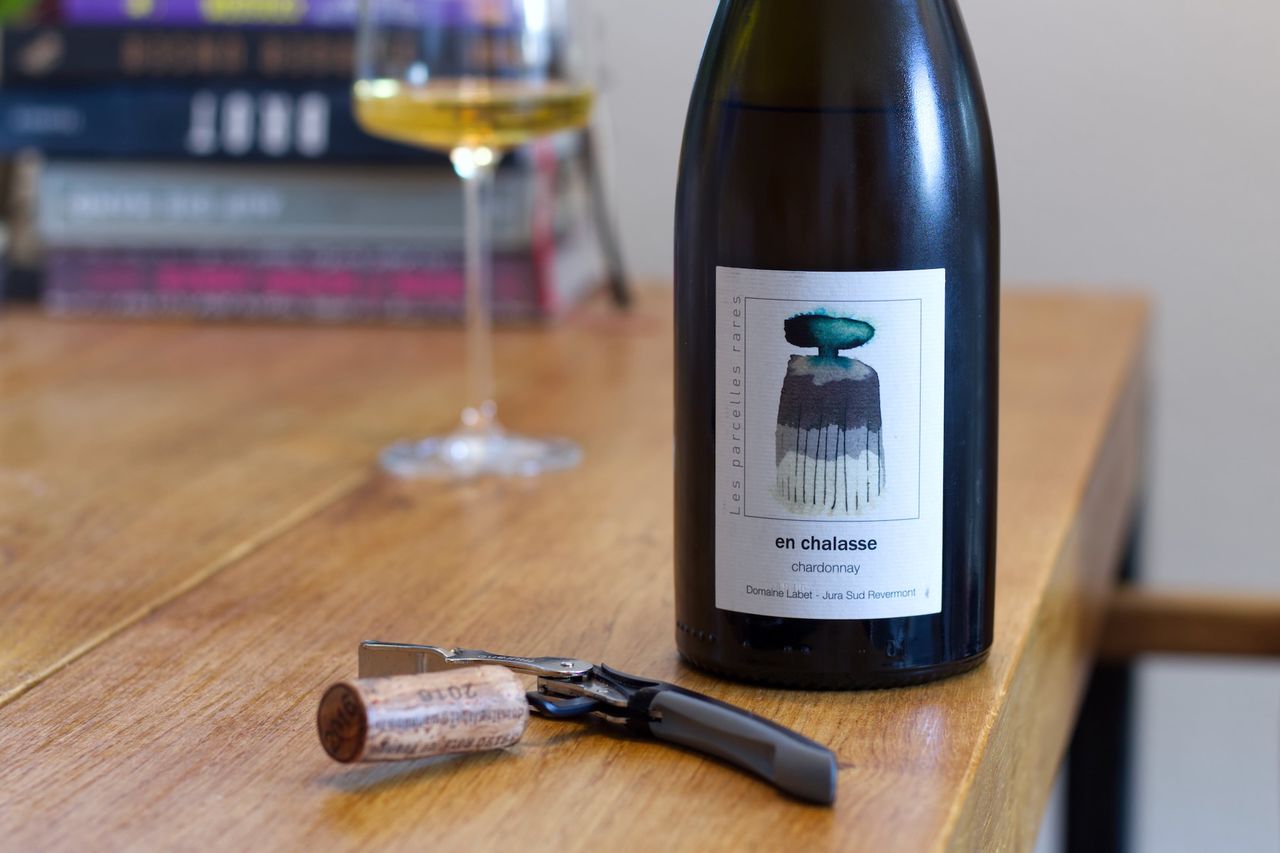
At least for me, when something was really good, I want more of it. In this case, “something” is the bottle of Jura Chardonnay from a few weeks ago. And “more of it” is this bottle of Labet. There’s no need to waste many words on Labet. One of those Jura estates that are simply hard to buy. Until recently, it was also one of those Jura estates that were still relatively affordable, provided you weren’t shopping on the secondary market. Unfortunately, prices have risen considerably. Of course, I can understand it to some extent. The past few years in the Jura have been marked by frost and hail, so that practically every harvest took a hit, and when, as a winemaker, you see what people are willing to pay for one of your bottles, it’s only natural not to let that profit disappear into the pockets of speculators. And if the estate still manages to get the wine into the hands of actual drinkers that way, then good for them. I don’t have to go along with it if I don’t want to.
Today’s bottle had already been lying around here. One of two bottles, in fact. No idea why I bought two bottles of this particular wine, given that we normally follow a fairly strict one-bottle policy. Even if that sometimes turns out to be unwise in hindsight. In any case, the other Chardonnay already got to make the arduous journey to the Karlsruhe wine circle earlier this year. And not only did it master the Württemberg–Baden border crossing without any trouble, no, it was also more than magnificent. So magnificent that I practically had to write about it. I like Labet if only because the space on the label is used for comprehensive information. The vines for this wine are a mix of massal and clonal selection, planted in 2006, 1985, and 1950. They stand on Lias soils facing south-east at an elevation of 265 meters. The wine is aged for 16 months in small oak casks, bottled on August 9, 2018, with a pH of 3.08, total sulfur of 13 mg per liter, and 13.2 percent alcohol by volume. It is made ouillé, meaning the casks are topped up rather than leaving the oxygen in the barrel. So you know exactly where you stand.
It’s immediately noticeable that a small, admittedly small, dose of sherry wafts from the glass. Now, you could say, sure, a 10-year-old white wine can have that. But the bottle in February didn’t. Not at all. And overall, this is the first bottle of Labet to show anything like oxidation. At least among the wines that weren’t made in an oxidative style. But that probably goes without saying. And it’s also rather unlikely that the wine decided to undergo flash aging in just these few months. So two possibilities remain: either we got extremely lucky with the bottle in February, or the closure on this bottle let through more oxygen than it should have. If I had to bet, my money would be on the latter.
There’s something nutty in there, grain, orange zest, and also that typical Jura spice. This has drive, really a lot of drive. The acidity is juicy but rather on the soft side of things, more orange juice than lemon juice. My drinking companion murmurs grapefruit, and as (almost) always, she’s right. With the white pith between the segments. For a moment I thought you could taste the oxidative note too, but every sip washes it further and further into the background. That’s how juicy it is. And good, too. All of which adds up to a somewhat absurd situation. Had it not been for the bottle in February, I’d now be writing about how well this has held up, how much freshness is still there, and just how juicy it is. This is exactly how I would have expected the wine to taste when pulling the cork in February. Only that bottle never got the memo, and now here we are. Over the course of the evening, the wine holds its shape without any trouble. Nothing changes anymore.
And the second evening picks up right where the first left off. This is more a wine for the mouthfeel than for the nose. You even get the sense that it seems a bit younger, a bit fresher today. Impressive how stable it stays, given that wines with a not-quite-sound cork often tend to fade quickly in the glass. Not this one, because it’s enormously fresh: plenty of citrus, juiciness, herbs, and stone. This is a truly lovely Chardonnay from the Jura. Even if it does not even get close to the bottle from February.
Related Posts
- Nicolas Jacob - Les Chazaux 2023
- Bruyére-Houillon - Les Nouvelles 2016
- Buronfosse - Les Ammonites 2018