Battenfeld-Spanier - Am Schwarzen Herrgott 2019
From Rheinhessen, we're drinking a bottle of Riesling Am Schwarzen Herrgott 2019 from Battenfeld-Spanier.
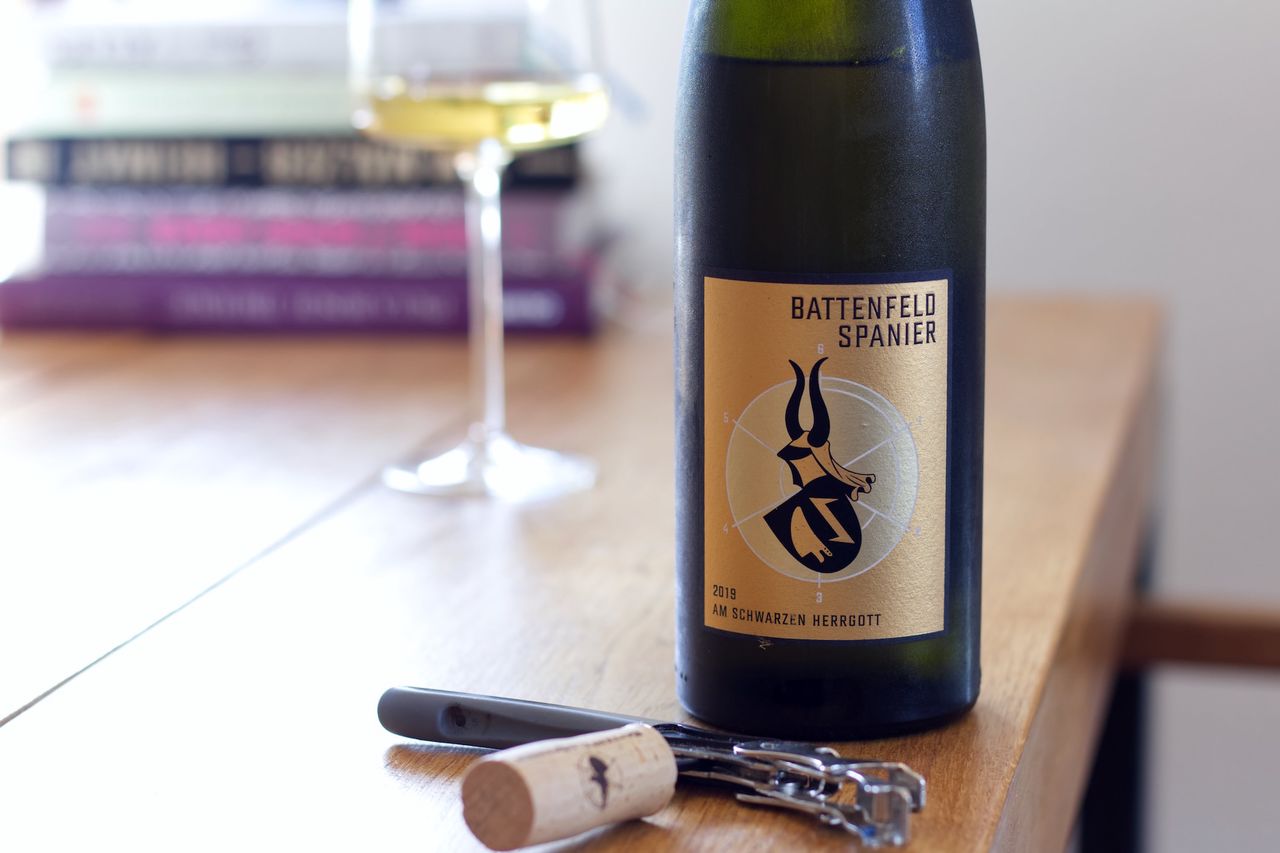
As mentioned in one of our recent posts, we didn’t make it to Rheinhessen for the Maxime Open this year due to time constraints. Fortunately for organizers and visitors alike, at least the weather seemed to be taking its leave from the collective mass sizzle. Because at nearly 40 degrees, our thirst for wine, at least, is no longer a thirst for wine. Water is the order of the day, perhaps alongside a non-alcoholic tonic-based mixed drink, or at most a bottle of fermented orchard fruit. But since we did think ahead in view of the weather forecast, this bottle has been pre-tasted and is thematically fitting, bringing us to Rheinhessen at least in the glass. Not to Ingelheim, though, the location of this year’s Open, but all the way to the southern edge of the growing region. A bit of background on Battenfeld-Spanier can be found in our last post about them, which is now already more than five years old. Wild.
This bottle of Riesling has been waiting roughly as long to be drunk. Its grapes grow in the Zellertal Am Schwarzen Herrgott, where, if you’re not paying attention, two steps further and you’re standing in the Pfalz. German wine law is surely of no concern to the grapes as they stand here on limestone, facing south. The grapes are hand-harvested, spontaneously fermented, and then aged in large, used wooden casks.
The Riesling needs no run-up. From the very first moment, it is intense, stony, more herbal than fruity, cool, and somehow, despite the intensity, keeping its distance. There’s citrus fruit, a touch of petrol, bright, yellow, and a hint of sweetness from extract or fruit peeks through the stone here and there, before nothing but stone and herbs remain again. The first sip is different than expected. Less intense, even more distant, slightly citrus-bitter, fine, herbal, and full of wet stone. The citrus bitterness refuses to leave, lingering endlessly on the tongue, and the next, slurping sip brings a solid dose of spice into play. But it always stays two steps behind the nose. It’s good. Really good. We’ve probably caught it in a lovely phase. And when the wine then dives down at the back of the palate, only then do you realize how much drive was in there all along. There’s more acidity behind it than you’d think at first.
It turns more classic overnight. The fruit is even more yellow, there are mirabelles on the nose, altogether simply more stone fruit. The acidity feels riper, more exotic, reminiscent of passion fruit and pineapple, juicy and no longer so herbal. And no longer so distant, either. How it smells and how it tastes have taken a step toward each other. There’s still practically no maturity in the wine. Petrol appears very briefly in every glass, only to vanish again with the first swirl. It seems almost fresher today, juicier, more Riesling. By now you have to force yourself to give the glass the attention it deserves. Not because it’s demanding. Because it empties too quickly. And then, at the very end of each glass, when only the last millimeter of liquid washes through the curve, you can tell it wasn’t bottled just this year. It seems riper then, even denser, so dense it would almost be too much, were it not for the freshness from all that juiciness. Then you pour another, and the journey starts all over again.
We treat it to a third evening. It gets softer, much softer. On the nose and on the tongue. The structure is now starting to become what it can only become after a few years. A bit of butter, creaminess, a touch of petrol, and a different kind of juiciness. Not as much citrus fruit anymore, less direct. There’s still a brutal amount of drive in there, of course, more mirabelle, a bit of forest honey, the herbs. And if the Riesling is still ramping up like this on the third evening, you could certainly wait a while longer before opening one. But pulling the cork now is a real joy, too.