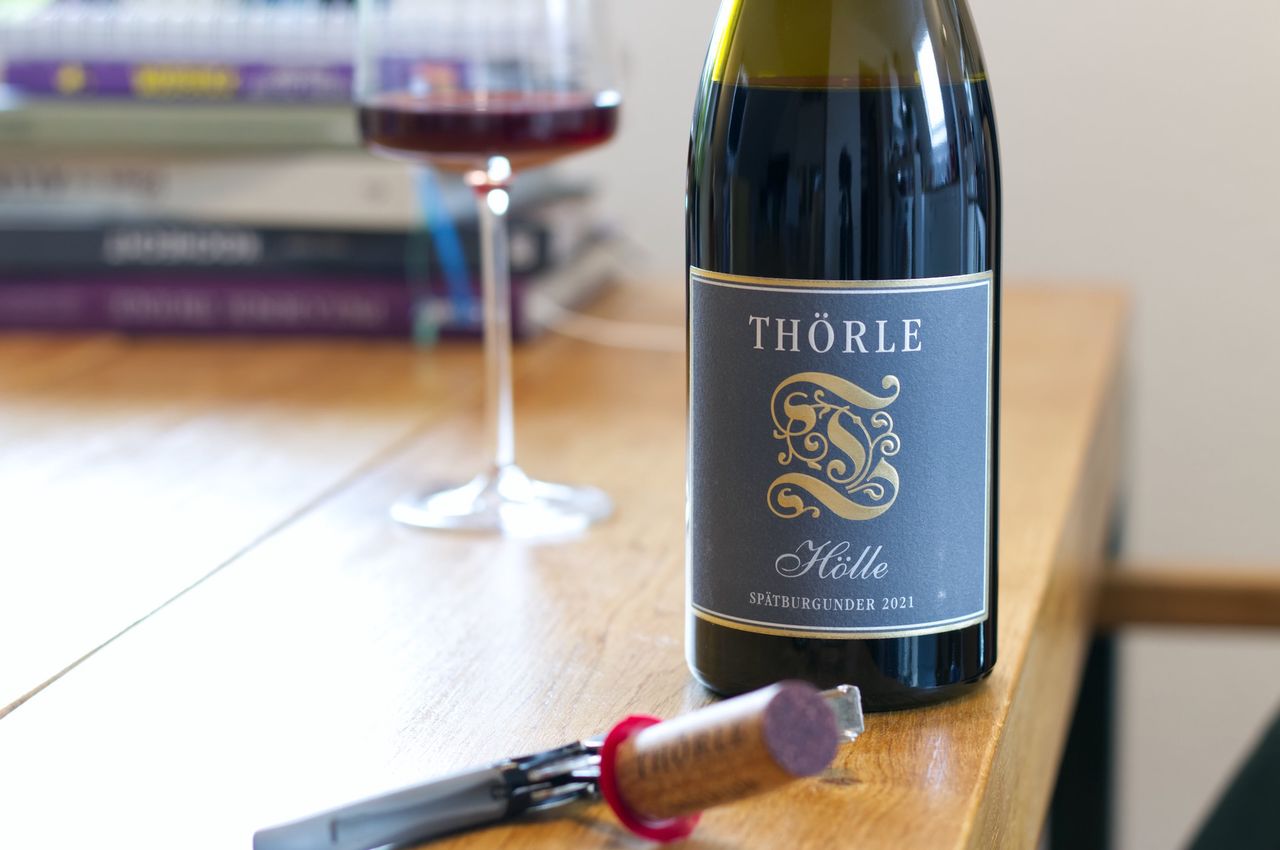
Thörle - Hölle Spätburgunder 2021
We drink a bottle of Pinot Noir from the Hölle vineyard at Weingut Thörle, from the 2021 vintage.
A few more weeks and it’s Maxime Open again. This year in Ingelheim, and this year without us. The timing doesn’t really fit the calendar this time, and honestly, a single location isn’t really the kind of thing I’d take on a few extra hours of travel for. Already last year I had asked myself when winery-hopping, where the path between the stops is also a big part of the point, starts turning into a wine fair with a bit more walking between the booths. No matter, this year the question can stay open for us. We had fun last year regardless, so much fun that we’re tacking on one more little follow-up. Both of the pictures from that earlier article are, as far as I recall, from our walks through the Hölle. Only logical, then, to revisit it in the glass as well, if only because the rooftop terrace at Thörle, after the walk through the Hölle, was genuinely lovely even in the drizzle, and because Thörle itself came up a bit short in that follow-up. It works out nicely, then, that the otherwise rather ambitiously priced bottle crossed my path in an offer that pushed it under the magic 50-euro mark. I’m a Swabian, after all.
Anyone who studies the vineyard map closely will notice that the estate sits right in the middle of the site. The vines, in other words, grow more or less right at the winery. The Hölle as a site is a south-facing slope, well, a little south-facing slope, about as much of a south slope as is possible on this patch of Rheinhessen. Even so, that makes it quite warm compared with the surrounding flat sites. I can’t find anything on how the 2021 vintage was made, but I assume it was vinified much like the current vintage. That would be a 60/40 mix of old and new oak, in which it matures for 18 months. Before that, it was spontaneously fermented.
The wine smells spicy and fruity, with currants and fresh oak. At first there’s a brief impression of warmth, but it quickly blows off with a swirl. In its place comes plenty of cherry and a touch of forest floor. It drinks exactly that way, too. First comes the acidity, then plenty of fruit in the middle of the tongue, and from the outside the tannin sets in. I like the way the tannin feels, but I find it hard to pin into a category. It isn’t coarse-grained, but it isn’t velvety either. It isn’t really furry, yet not soft and yielding either. It happens somewhere in between, with the sense that the last few years have already done it good, but the years to come will surely do it even better. The wine is long, and it keeps gaining a touch more cherry. Right now, though, this is a wine for the mouthfeel and not so much for the nose.
The later the evening, the more undergrowth joins in, the spicier it gets, and the more the intense cherry recedes again. I like the spice, the bit of balsam wood, the red hibiscus, the structure. The nose is catching up.
It grows softer on the second evening, rounder. There are a few rose petals, still the cherry, some lilac and spice and oak. It’s fascinating how the structure has become both softer and grippier at the same time. It now digs in at the back of the tongue and refuses to let go. Wine simply stays exciting, every bottle, every glass has the potential to surprise. I still think a few more years would surely do it good. Also, and perhaps precisely because it already pleases so much now and yet, with every swirl, every minute in the glass, opens a door or a window a little further somewhere. That with every sip you can dig the vineyard and the rooftop terrace back out of the back of your mind will surely play its part, too.