Two Bottles Daniel Schweizer
We're drinking from Daniel Schweizer of Württemberg a Cuvée Weißer Brunnen 2022 and a Burg und Berg, Pinot Noir and Syrah, from 2021.
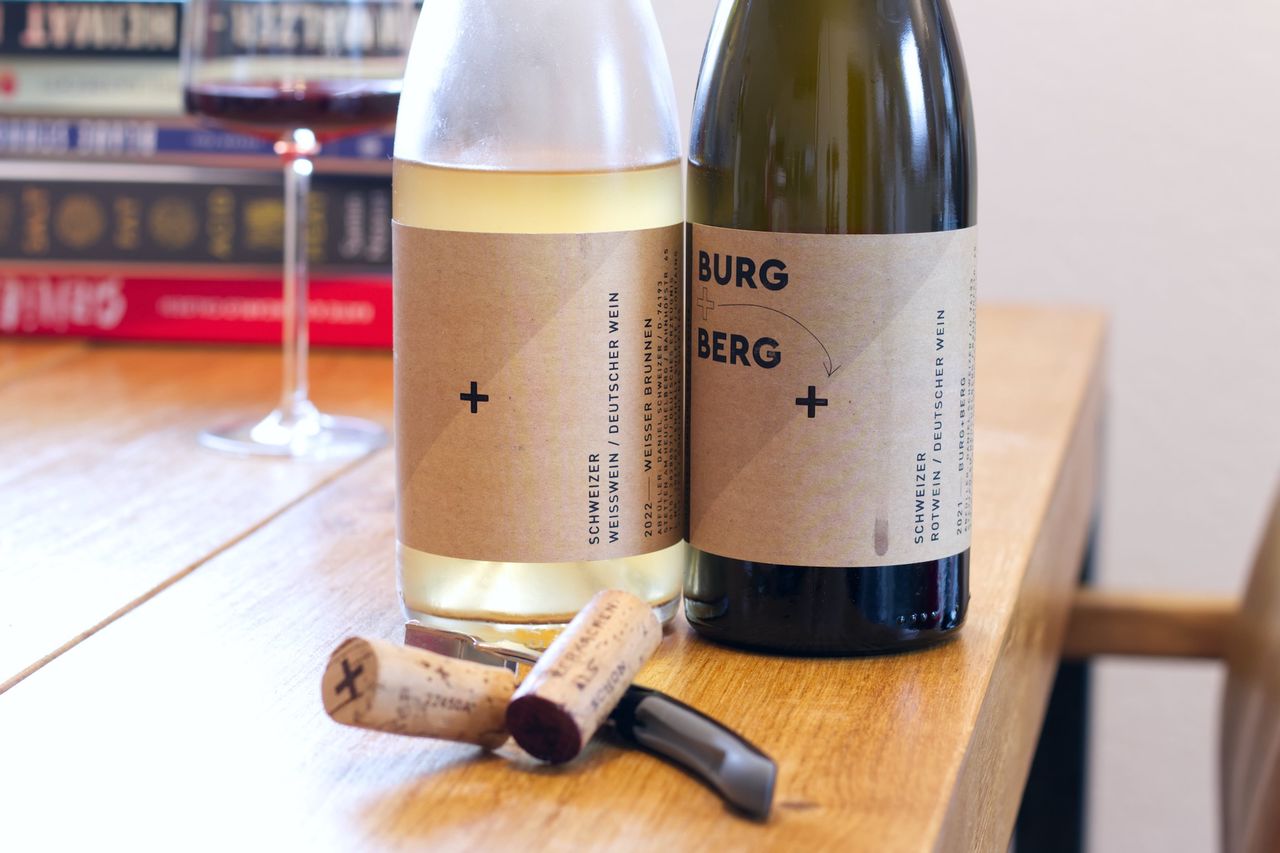
Wisdoms that winemakers print on tree bark. Today: Better to fully botch it than be shit from the start (roughly translated). Daniel Schweizer, who enriches our lives with these words, has been making minimally invasive wine since 2014 west of Heilbronn in Schwaigern in beautiful Württemberg. The vineyards for it lie around Stetten am Heuchelberg (the “am Heuchelberg” part is important, because there’s more than one Stetten where wine is made). Neither Schwaigern nor Stetten a.H. are likely to make a flag pop up on the inner map of most wine drinkers, but maybe we’ll change that today. Daniel farms three hectares, of which roughly half is worked with a tractor, but the other half is worked exclusively by hand or with a horse. Already the second winery within two weeks that has soil-working implements pulled through the landscape by hooves. Daniel has been doing this since 2016 and that, even if one can hardly believe it, is now a whole decade. Whether the wine comes from a horse-worked vineyard, by the way, you’d recognize by the symbol on the label. I can’t tell anymore because the perspective unfortunately doesn’t allow for it and the bottles, once again, are already in the recycling bin.
We’re tasting two wines today. The bottle of Weisser Brunnen 2022 is the entry-level wine in the range and a cuvée of Johanniter, Saphira, Riesling and Gewürztraminer. The two PIWIs are pressed directly, Riesling and Gewürztraminer spend some time on the skins. Spontaneous fermentation goes without saying for wines like these, the ageing takes place in wooden barrels. And of course there’s neither filtering nor fining. Burg und Berg is a cuvée of Pinot Noir and Syrah from the Heuchelberg. Both varieties are aged separately in a mix of larger and smaller used wooden barrels. And if I still remember correctly (and after cross-checking with photos in various webshops), if you turn the bottle a bit, a horse symbol would appear.
We start with the Brunnen. For the fact that parts of it stood on the skins for up to 18 days, it really doesn’t smell orange at all. But it does smell of orange. As in, the fruit. There’s a lot of structure and actually relatively little fruit, but the fruit that is there has something lemonade-like about it. With a dollop of BBQ sauce next to it. This has real pull and is once again a ride on the razor’s edge in terms of acidity. For me one step too far, across the table it’s celebrated. But I like how juicy the wine is, how cool and how straightforward, and although it’s wild, it’s not crazy wild, and the aromatic varieties show relatively little aroma and instead a lot of structure in this wine. With the wine in your mouth, the nose turns greener and then there’s a bit of Muskateller after all. Exciting. Not necessarily my thing, but I can acknowledge that it’s well made, or rather not made but become, but then yes, somehow also made. And that the bottle won’t survive long at our table even without me, that’s beyond question anyway. I’ll just stick to smelling, because the mixture of lemonade, herbs, freshness and a bit of smoke. That’s really lovely.
The tonic freshness the wine retains overnight. It now somehow reminds me of eucalyptus and the acidity is tamer. I suspect that’s the Traminer slowly coming through. Unfortunately, the tannin starts to fall apart a bit on the back end. But thanks to the length and the spice, it doesn’t stand out all that much. A ride on the razor’s edge indeed, but one that’s worth it.
The Burg und Berg is reminiscent of Islay. Herbs are there, peaty smoke and lots of spice and structure. This too is a wine that does have fruit, but that comes through much more via its spice and structure than via the fruit. It already smells juicy, red and of cherries with fresh wood. On the first sip I have respect for the acidity, on the second sip I’m then surprised at how clean it feels. Smell and taste only really come together far back on the tongue. It’s so clear in its acidity and at the same time so fruity-fresh that only the slowly expanding wood builds the bridge to the nose. With air, the wine becomes ever darker in its aromatics. This has depth and needs time. I hope it has that time.
And I have to apologize to the bottle. This kind of red wine tends to leap off the cliff on the second evening. The type of acidity, the way the tannin feels, that’s often beautiful for one evening and then simply no more. Part of me had therefore preemptively put a check mark behind it, because dampened expectations also dampen the disappointment. But I was wrong. Islay doesn’t return, but structure and acidity, smoke and old wood, cherry juice and herbs, all there. It seems rounder than on the first evening, more balanced, somewhat more mature and more open. I like that very much on this second evening.