From Apple to Cider
We made cider. Bottle-fermented. Ourselves and without really knowing what we were doing. A travelogue from apple to cider.
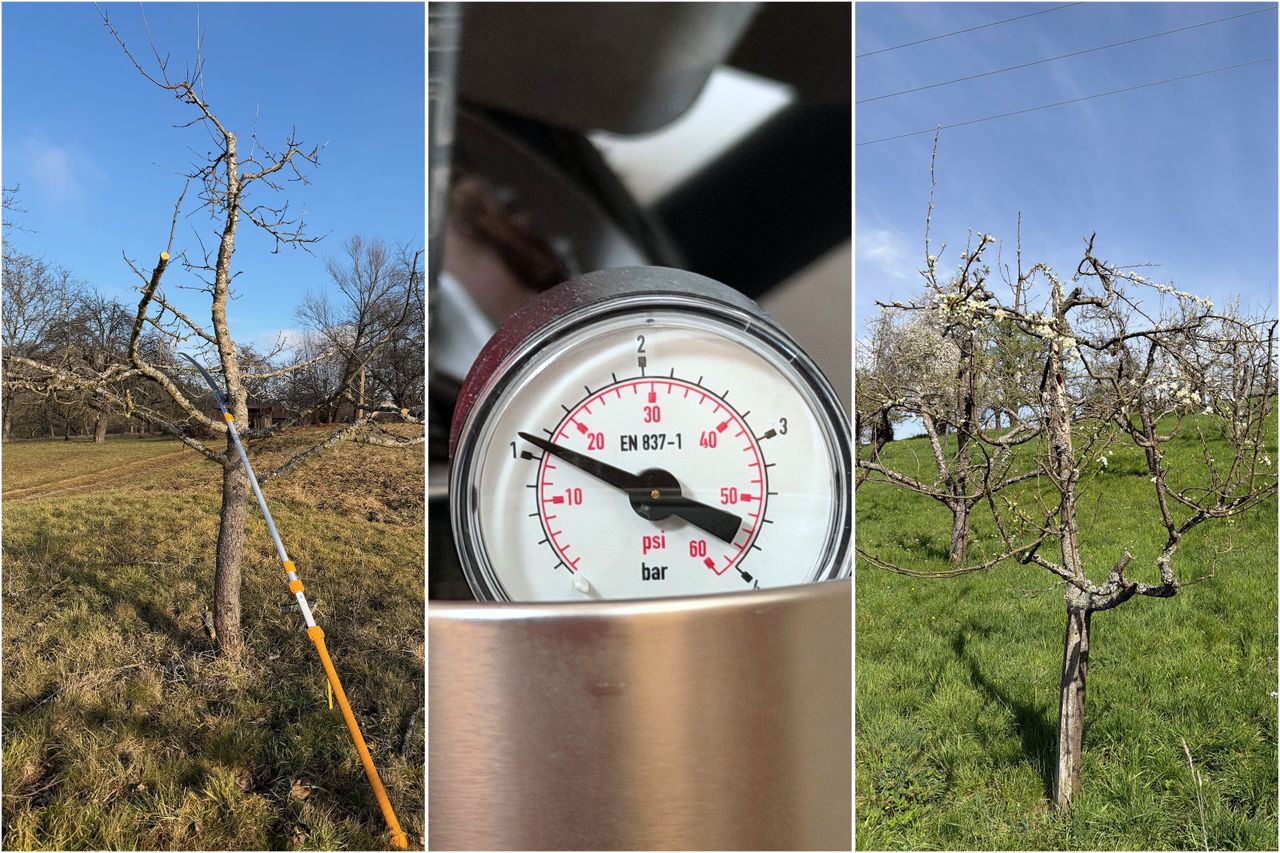
The apple year starts early. Mid-February perhaps. At our place, at least, and depending on when the scales tip from “it’s still bloody cold” to “now we really ought to get on with it”. Usually that’s a sunny day in February. Right upfront: with everything we do on the meadow, we have the luxury of not depending on it, of not being reliant on it. If the days are too rainy, the spontaneous fermentation too spontaneous, or the apple year a rubbish year, it hurts, but only emotionally and not in the wallet. And so we have the luxury that it can be a sunny day on which we happen to have time. If that day only comes in March, then it only comes in March. But that also means we can never really empathise when the hail comes, or the drought, or both. Still, the connection to apple, pear and co is a different one. Because orchard meadows here at the edge of the Swabian Alb in beautiful Württemberg, the most lovely little spot on this planet, as the saying goes, are a defining feature of the landscape. It is the cultural landscape that shapes every car drive, hike or bike ride here. Stückle, Gütle or whatever you want to call it, it is part of life. And sadly somehow not anymore. The trees aren’t tended, the meadows aren’t mown, and from orchard meadow to bramble thicket is but a stone’s throw. That, really, is the main reason we trudge up and down the south-facing slope, pick up the saw and slather sun cream on our necks already in February. I hate sun cream, sun cream with sweat running into your eyes I hate even more. But the orchard meadow must survive.
And if you preserve the trees, replant, take care, then in return fruit comes off them. We don’t spray, we don’t fertilise, we only leave the lawn clippings on the meadow because hauling them off would simply be too much effort. So what we get is in fact unsprayed orchard fruit. That we generally enjoy drinking fermented orchard fruit should by now have got around. Preferably with bubbles in it, and after the first cider experiment three years ago worked out well, and two rubbish years in between were ridden out, the thought slowly ripens: “How hard can it really be, this bottle fermentation thing?” How hard can it be.
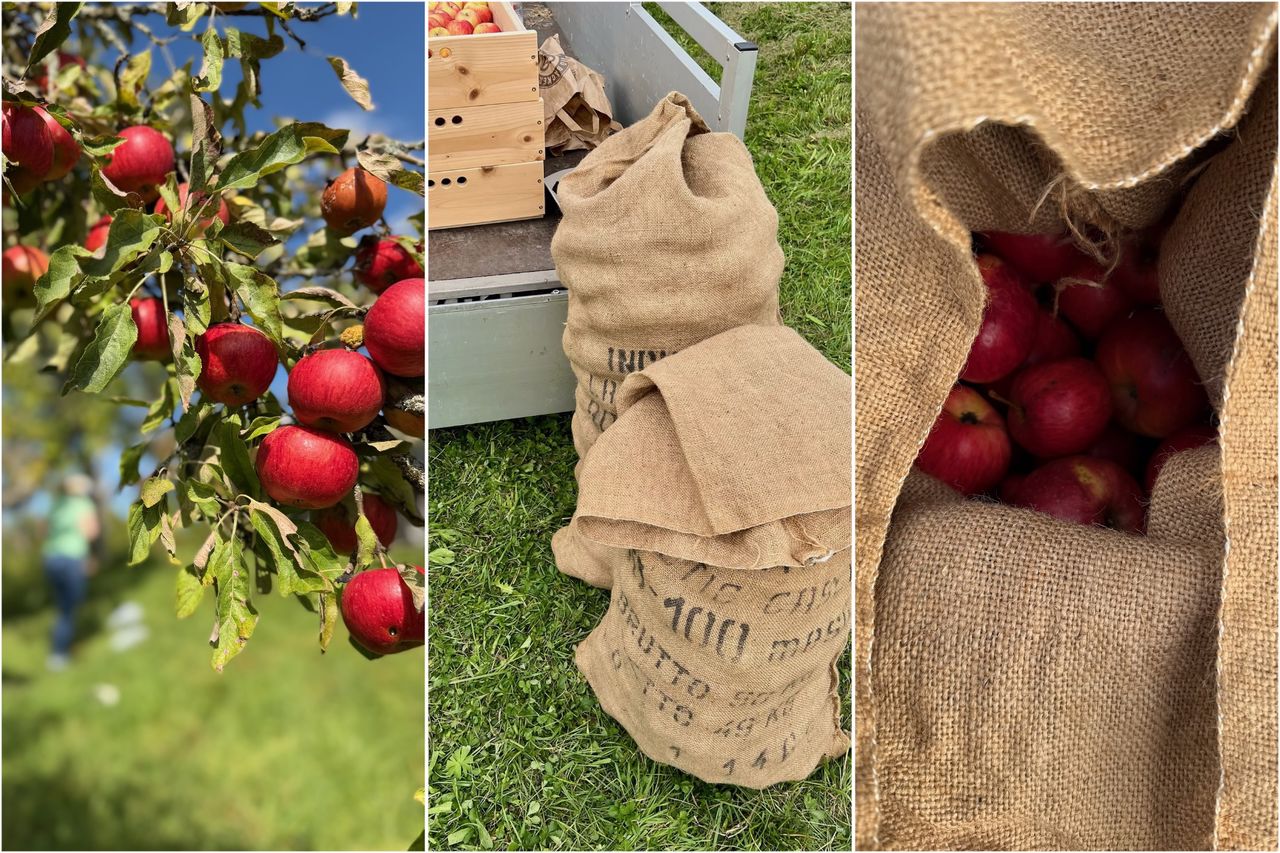
We jump to autumn. 2025 is a good apple year. 2025 is a very good apple year. After we had a single tree with a few fruits in 2024, this year the trees hang so full that on at least three trees larger branches simply broke off. Despite props. I genuinely can’t recall ever having seen the trees on the meadows as full as in this year. Everything bends under the weight. We first harvest with the ladder what we want to put into storage. And then we shake. Even so, we don’t manage to harvest everything that’s on the tree. Because time is limited, and rather than delivering it for a few euros, we’d rather put the time into our own processing. Even if that means a part will simply be left lying. We often don’t really know what we are harvesting. There is a drawing that says which tree should stand where. But Grandpa thought grafting was really cool, and so we have trees with four, five or even more varieties, of which some have surely fallen victim to the saw too. As mathematicians like to say, without loss of generality (and based on the list): Idared is there, Gewürzluiken, GoldRush (not quite ripe), Glockenapfel, Jonagold, Boskoop, Elstar, Rubinette, Gala, James Grieve, Berlepsch, Topaz and Melrose. We pick up what falls down and have no idea what will land in which press.
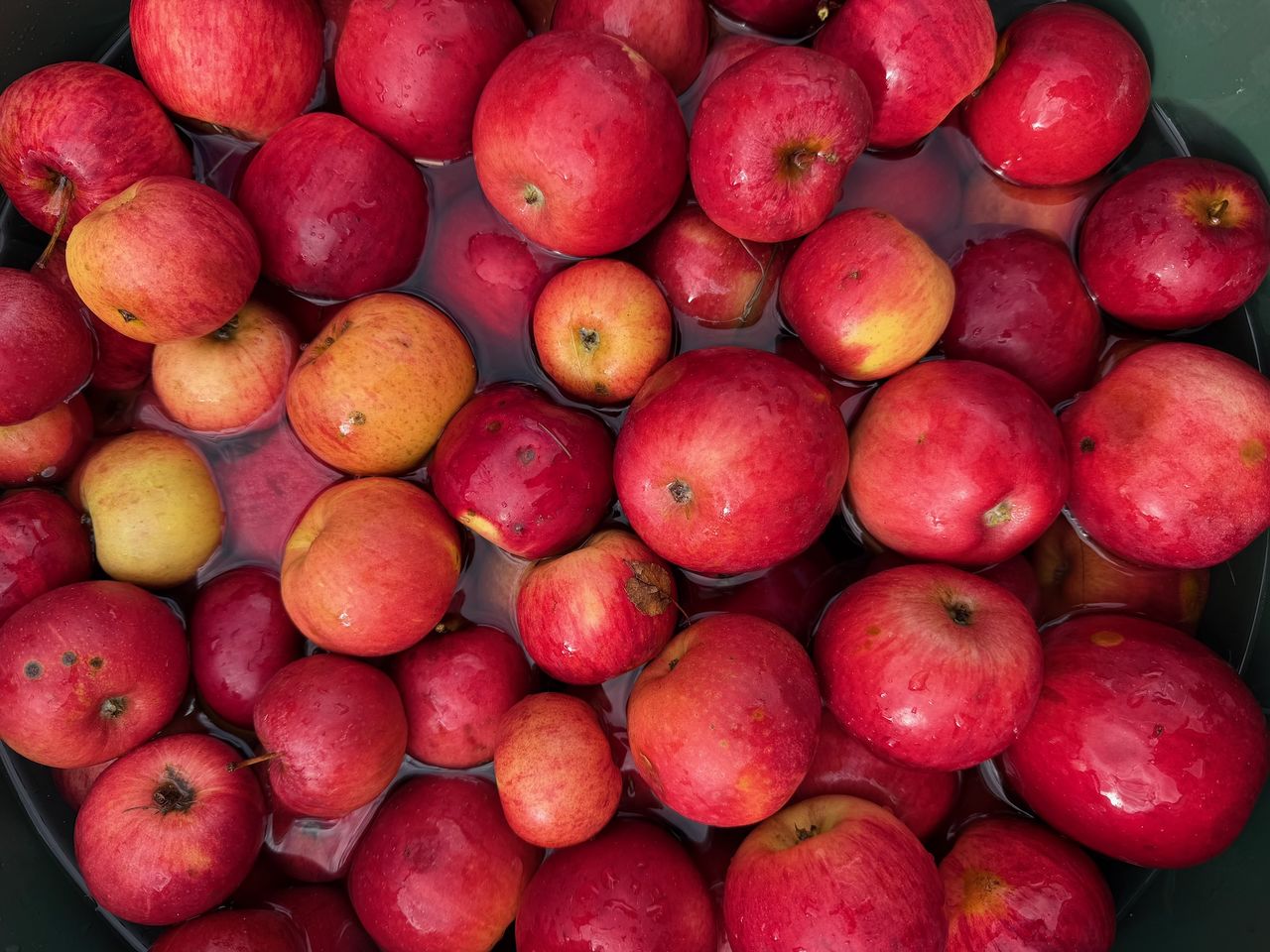
The gathered apples land in jute sacks and the jute sacks, due to scheduling reasons, sit cool and open at the top for two weeks. That is, because apples ripen further, fundamentally not a problem and actually even good for sugar content and flavour. Flat harvest crates, in which not quite so much pressure rests on the bottom rows, might be better. We don’t have them though. What follows is meditative work. All apples go for one bath, the completely rotten ones immediately fly out, the rest get cut open once. Anything that is brown, or whitish-furry (the bore tunnels of the codling moth in particular tend to form fur) is discarded. On every single apple. That may be overkill, but it certainly won’t do any harm.
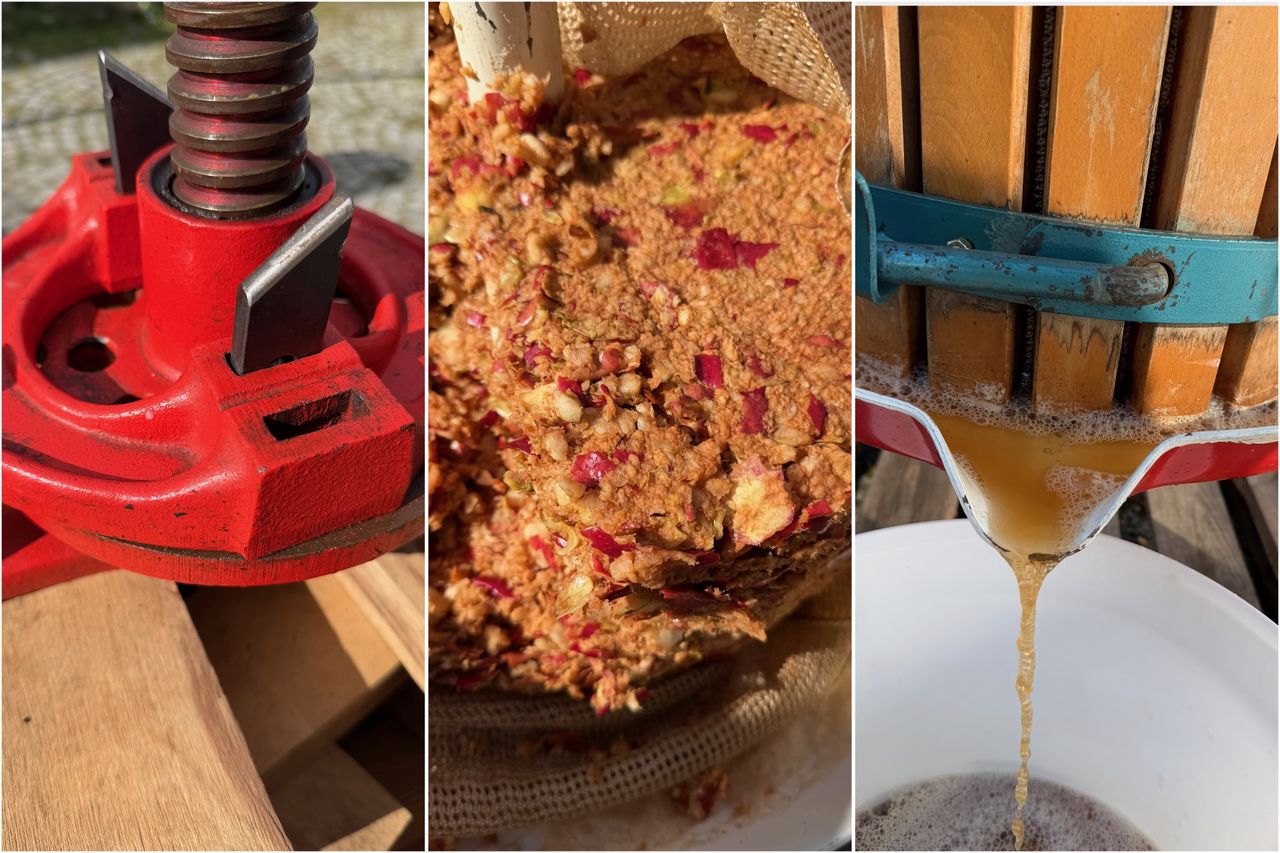
The apples are then ground in a fruit mill and pressed with a wooden basket press. This would be the moment when we should have measured the sugar content, but without a refractometer or must hydrometer that proves difficult. Next time, then, the refractometer is now ready and waiting. A large part of the juice disappears into a pressure tank that, after fermentation has started, gets closed at the top and last time kept the cider fresh for three years. A small part disappears into two 30-litre plastic barrels. No yeast, no filtering, no sulphur, no nothing. Just apple juice, a barrel and an airlock on top. For anyone who doesn’t know what that is: it’s a stopper which, thanks to a liquid seal, lets carbon dioxide out but doesn’t let oxygen in. And then it’s a matter of waiting.
By now it’s the end of October, it’s getting cold outside and therefore in the cellar too. The yeast isn’t really in the mood. After even four days no bubbling whatsoever can be seen, the barrels move up to the hallway. With 30 litres that’s thankfully no problem to do. Then it gets going. First tentatively, then with foam in the barrel and ever more frequent bloops from the airlock. We carry them back down, because cool temperatures are said to be conducive to preserving fruit aromas. The plan is to leave the whole thing alone as much as possible, and the most minimally invasive form of fermentation monitoring in this case is the smell test on what is bubbling out. Apple-y it smells, fresh. At least for a while. Then the sulphur fart starts. That describes it pretty well, what is now bubbling out of the airlock. And you can’t quite tell, is it still stinking, or has the liquid in the airlock absorbed the sulphur compounds and is now giving them off itself. But that too passes and it smells of apple again. Spontaneous fermentation does spontaneous-fermentation things.
Curiosity grows and we taste. Neither of the two barrels smells of eggs. Relief. One is wild, a little volatile and still cloyingly sweet. The other has brutal grip and seems already much, much further along, even though both are bubbling at roughly the same rate at this point. If only one had measured the sugar content at the beginning, then one could now at least make a rough estimate of the fermentation progress. So it’s lid back on and wait.
It takes and takes. Where the barrels stand it’s pretty chilly. From February we’re at one bloop per minute, by early March one bloop every three minutes. Mid-March then silence. At least in the left barrel. And even a few warm days don’t change that. We decide that the time has come.
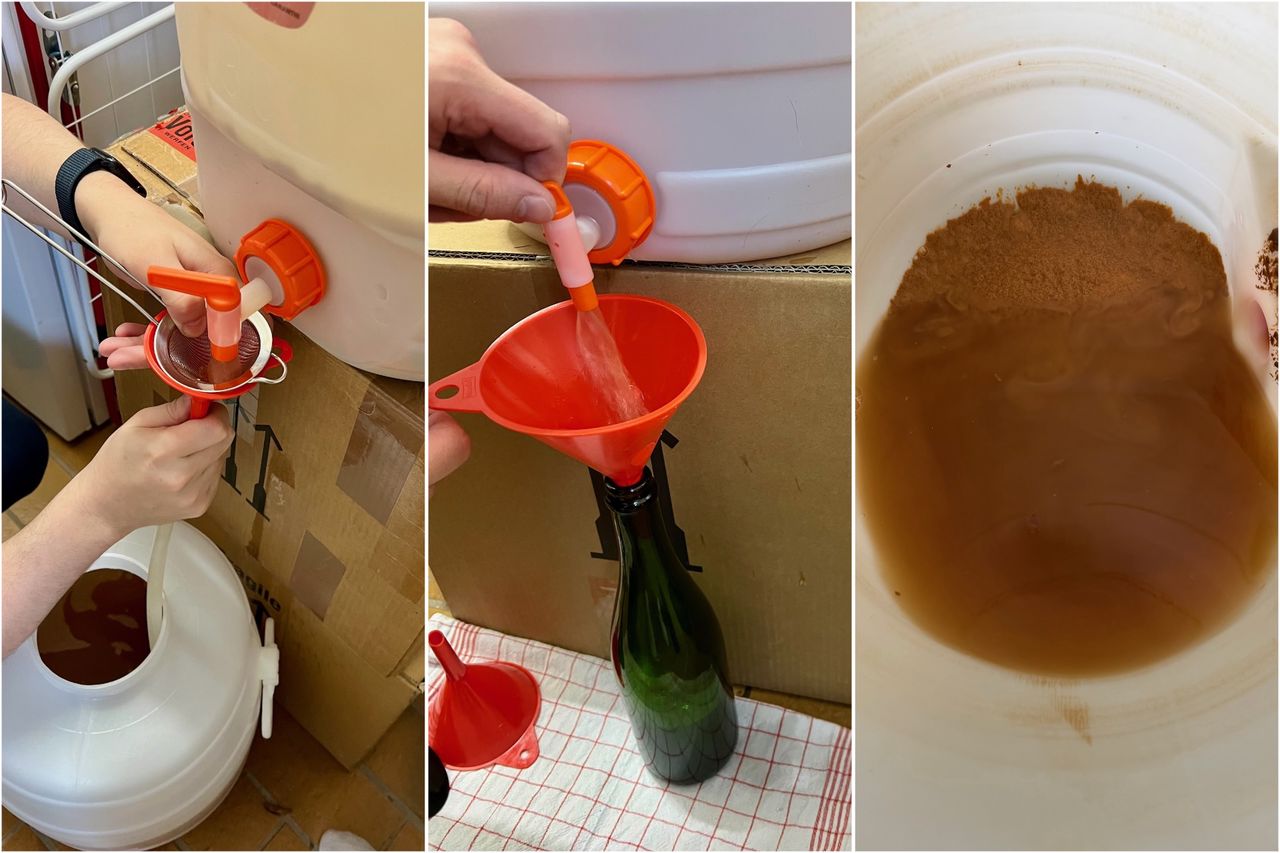
The plan is simple. We have sorted out champagne bottles (over 700 grams per bottle, suitable for bottle fermentation, new glass), a hand-capper, an assortment of crown caps with either one or two sealing rings, and a few bidules. Bidules are little plastic thimbles you can stick into the top of the bottle under the crown cap. That’s meant to help with the seal and make disgorging easier. We won’t be disgorging, but we’ll try out the bidules anyway. Crown caps with integrated bidules we also bought, but the hand-capper can’t crimp those. Never mind. We clean the bottles with minimal washing-up liquid and lots of water and let them drip-dry upside down.
Two bar of pressure is the target. And this is also the right place for the note that all of this is many things, but it is not a how-to. Four grams of sugar per litre are metabolised by yeast into a bit of alcohol and enough gas for one bar. Four grams of sugar, that’s almost nothing, that’s Extra Brut, that’s not even a teaspoon, that is, between yeast, acid and tannin right after fermentation, a real sensory challenge. One bar of pressure more or less in a glass bottle, however, that is, depending on the glass bottle, the difference between delicious bubbles and glass shards in the face. And perhaps the customs officer at the door, because at three bar you enter sparkling-wine-tax territory. The imperial fleet has to be paid for, after all. Two bar are accordingly 8 grams of sugar per litre, 6 grams per bottle and 5.8 grams in our case to have a bit of room. Lucky thing we bake bread according to recipes that call for 0.x grams of yeast and weigh coffee for the pour-over. So two precision scales are knocking around here and the weighing goes astonishingly quickly. Sugar into the dish, funnel onto the bottle, sugar into the bottle.
Trust is good, control is better. I would like to know what’s actually going on in the bottle. There are pressure gauges for champagne bottles, customs has to be able to measure too, after all, and also instructions for DIY solutions. The ones you can buy are unfortunately prohibitively expensive and DIY isn’t an option with my two left hands either. Luckily there are pressure gauges for swing-top bottles in the home-brewing supplies world. They only go up to four bar (doesn’t matter to us, since we’ll be staying well below that anyway) and have to be fitted to swing-top bottles, but that is the perfect solution. The pressure gauge doesn’t care whether the yeast is swimming in apple or in barley. So accordingly less sugar goes into a swing-top bottle, which in turn will be housed inside the metal tube of an old whisky bottle. I knew I’d be able to use that again sometime.
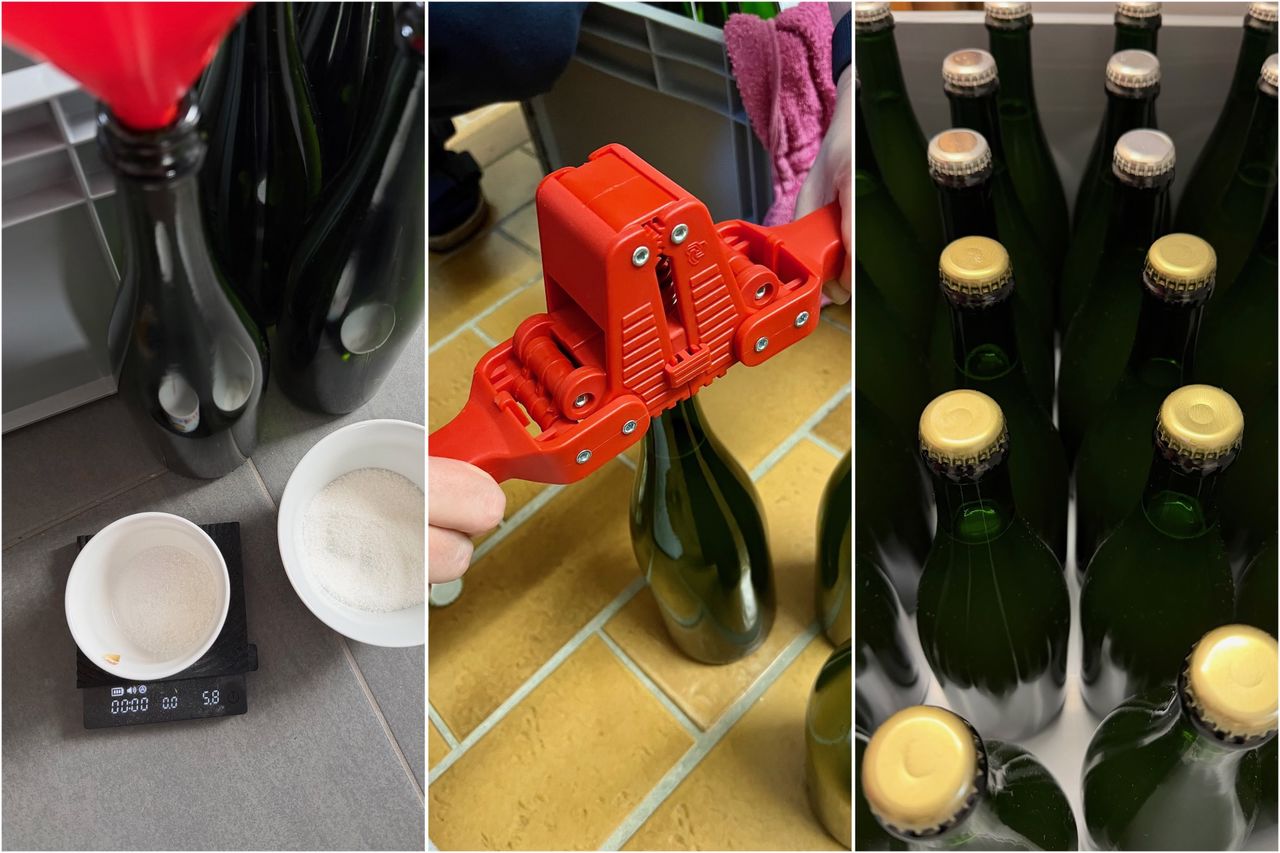
We rack once from the fermentation barrel through a tea strainer into a fresh barrel to get rid of the sediment. It’s still cloudy nonetheless, and a few days in the second barrel might have been a good idea. It tastes surprisingly austere. Lots of yeast, a touch of glue, no fruit. The alcohol dowsing rod, aka vinometer (a little glass tube that is supposed to measure alcohol content via capillary action and surface tension), shows 7 percent. A sachet of EC1118 sparkling wine yeast gets to rehydrate and then disappear into the must. That then goes into the bottles and on top goes the crown cap (a few bottles in each variant). The yeast is supposed to cope well with pressure and settle out nicely after its work is done. We’ll see. Since the sugar doesn’t really want to dissolve, the bottles stand still at first and the next day are turned upside down once. By then no sugar can be seen anymore and they all disappear into grey, thick-walled Euroboxes. As I said, safety and all that. The reference bottle stays in the hallway. The idea would be that the higher temperature and thus faster fermentation gives us enough time, in the event of a mismeasurement or too high a residual sugar content, to be able to emergency-vent the bottles in the cellar.
On the first day the gauge climbs to about a quarter bar and stays there for the time being. From then on, after two or three days, it climbs continuously. When the gauge then doesn’t stop at the projected terminus of two bar but cheerfully sails past it, panic spreads. At 3.5 at the latest we would remove all crown caps, everything back into the barrel, sugar it up and drink it like that. Thankfully it doesn’t come to that, after 16 days, things stop at 2.7 bar. Part of the excess will simply have been bottled along with fermentation CO2, part is physics (you have to know that), because in the hallway it’s now well over 20 degrees and warmer means more pressure, and part is perhaps simply sugar that the spontaneous yeasts didn’t want to eat but the EC1118 did.
What’s left is drinking. A week after the end of fermentation, the first crown cap has to give way. Well chilled, outside and with much caution. Apart from a bit of a hiss, however, not much happens. If you read the web, then this should now have blown up in our faces, given the unfiltered bottling. In practice that doesn’t appear to be the case. Bottles with yeast and turbidity we still respect though, one or another pét-nat has played its part in that. Yeast dominates. A touch of volatile acidity has stayed, the glue too. It needs air, until apple, apple skin and marzipan join in. The bubbles disappear quickly, which is certainly down to a lack of time for integration. And the chances are also not bad that the cellar bottle is not yet finished with its fermentation. It’s good though, and the feeling that you’re drinking bottle-fermented cider that you have put on bottle yourself, that simply cannot be beaten.
And the observation bottle, too, gets its turn after another two weeks without any change in pressure. Cooling sleeve, fridge, shower cabin. Hiss, just as unspectacular as the first. And with just as much glue as the first bottle. What is no longer there, though, is yeast. Because the bottle was upright from the start, there was enough time for clarification. Against the champagne that happens to be open at the same time, the bubbles can of course not compete. But, and this is the decisive point, they are noticeably more persistent already than they were on the first bottle. Time really does help. The glue recedes, more fruit comes through, more mellow apple, more marzipan. It is significantly less austere by now. On the palate taut, hardly any fruit and with enormous grip and a touch of tannin far back on the tongue. Maybe it was a few green GoldRush too many in this barrel. But fishing them out again now isn’t an option either. The volatile acidity, too, has vanished, only the glue, that remains. There’s apple skin on the nose, mellow stored apple and meadow. The more you drink, the fruitier the acidity becomes too. Realistically, much more than two weeks lie between the two bottles, simply because it is so much warmer up here. But those two weeks have changed a lot. Rounder it is, more harmonious, more cider. The last glass is then, as with pét-nat, accordingly cloudy and yeasty. Every burp a beer. And with the yeast, the fruit develops something gummi-bear-like. I like that even more than I did the first bottle.
It is impressive how far you can get, completely clueless. With plastic barrels that stand on bottle-bank cartons for bottling and cheap plastic funnels, with ancient wooden presses, jute sacks, hand-cappers, coffee scales and love.
And so we are back where the year began, or rather ends, when it comes to cider-making. At least when spontaneous fermentation takes its time. You’re already pruning the trees again, then looking at the blossoms and waiting for autumn to come round once more. Only now with a glass of cider in hand, a glass of cider from precisely these trees. And when autumn does come, well, then we’ll do cultured yeast next time, just to try it out, perhaps single-variety, Boskoop or something. And more bottles. And with a better capper. And in Euroboxes with reinforced bottoms, because without reinforced bottoms the whole business is alarmingly wobbly. And two batches in parallel. And maybe with labels. And with measuring and writing down and all that. And, and, and… And until then, we’ll mow once, twice at most, and otherwise we’ll watch how a cider like this develops. There are still 28 bottles waiting to be tasted. Purely for science, of course.