Ziereisen - Jaspis Hermann 2021
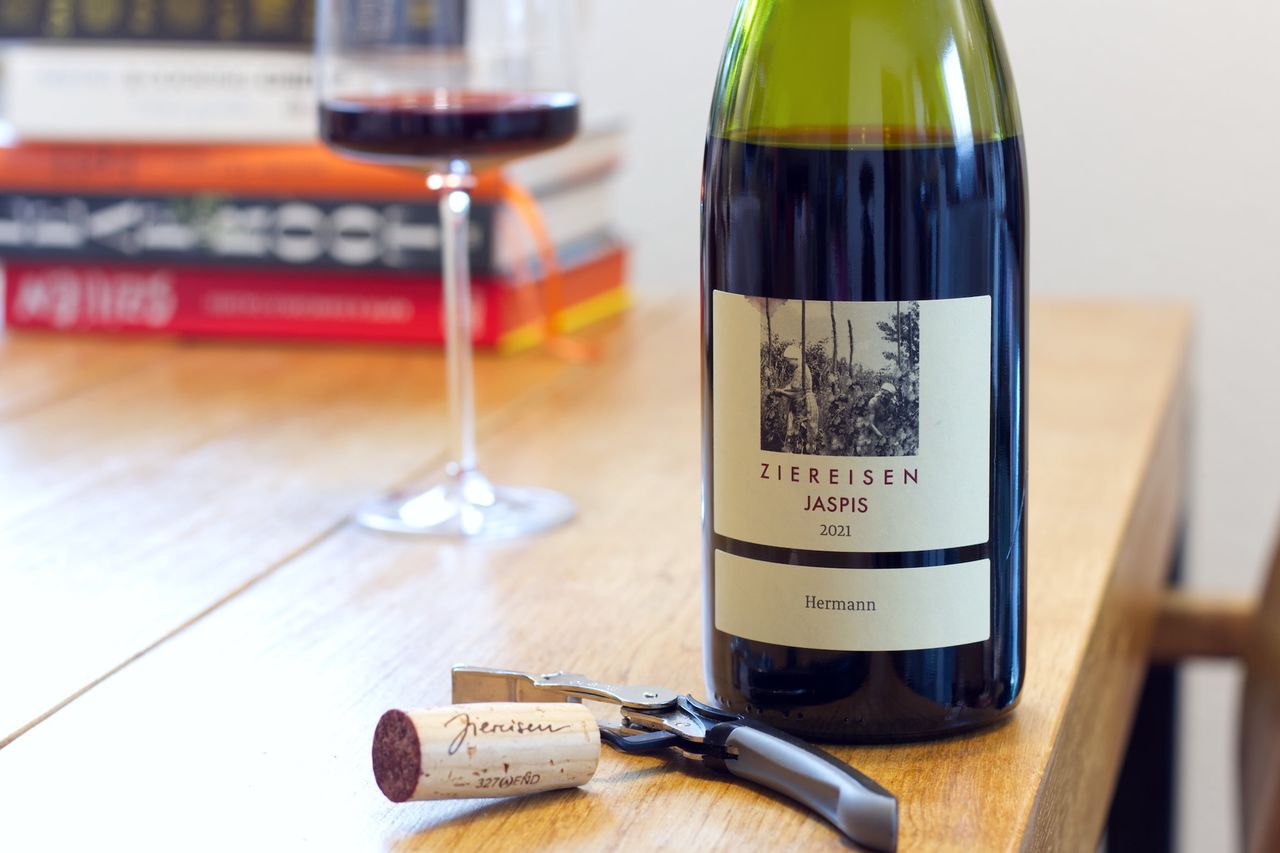
We are drinking a bottle of Hermann Spätburgunder 2021 from Ziereisen's Jaspis collection.
The height of the shelves at wineries one might reach for is a question you very quickly find yourself confronted with when you get a bit more deeply into wine. The first magical threshold you cross is probably 10 euros. Double digits. For a bottle of wine. The next big threshold was and still is 50 euros for me. Even though by now it feels like almost every run-of-the-mill GG casually smashes through that mark with its ass. At that point you’re already in a range where everyone else looks at you wide-eyed and files you away in the crazy drawer. There will be further thresholds, three digits, four digits, utterly-insane digits, I genuinely don’t know, because the 50 still works very well as a boundary stone. Even if we pass it a bit more often than we used to. Some wineries or styles only just begin there, Champagne for example, Burgundy, Barolo and company. Some wineries start at the front, but stretch across several thresholds, and if the beginning of the path already brings a lot of joy, then the question of how far you want to go along it becomes much more pressing than when the path only starts way back there anyway.
Ziereisen in the far south of Baden is one of those wineries. And we’ve already gone quite a good stretch of the way. Schmätterling Rosé from Regent and Pinot, Heugumber Gutedel, Steingrüble and Viviser, Lügle and Talrain, Hard, Gestad and Schulen, we’ve really gotten around in Ziereisen land. Only Jaspis, Jaspis is still missing. And that’s why today we’re doing Jaspis. Not 10hoch4, that can stay far away on the horizon, but Hermann. Hermann is a selection from Talrain, but vineyard names aren’t even allowed as allusions on the bottles anymore. Steingrüble, uh Steinkrügle, uh Gutedel ST can sing a song about that. So Hermann, which has only existed since 2021, we’re drinking the premiere. The vines for the wine grow at about 500 meters above sea level on limestone with iron-rich clay. It is then matured for two years in used wood before, like all wines from Ziereisen, it goes into bottle as Landwein. We’re planning on three evenings, since the wine is still pretty fresh in bottle. But curiosity wins again.
There’s really a lot going on right from the start, not loud, not in your face, but a lot. There’s spice, something ethereal, juniper, a little artificial cherry and real cherry is there too. Very clear in its aromas, and every time you put your nose in the glass, a new impression comes back. Juicy, fresh, and then the tannin comes in. It actually still feels a bit unfinished. Not scratchy, but furry in a way that isn’t especially charming at the moment. In terms of flavor, the Pinot is exactly as tightly packed in its aromatics on the palate as it already was on the nose, with great fruit between the fur. I’m curious to see what the three evenings will bring and I’m looking forward to it.
A whole lot hasn’t changed, but we also didn’t really remove much from the bottle. The portion intended for the evening now gets to deal with oxygen in the Erlenmeyer flask in the hope that this will speed things up. The acidity feels wilder today, you think you can already smell that and you can taste it too. It actually seems younger than it did on the first evening, more unfinished, more impetuous. The first tasting glass, the one before the flask, needs quite a lot of swirling to get itself sorted again. But then it just gets better and better. The tannin softer, the finish longer, and acidity and core together are a brilliant combination. There’s pull behind it, power, without becoming loud. You have to listen closely, but then it draws you in completely. There’s so much depth there. The smaller the sip, the fruitier the fruit, the more fruit juice the acidity becomes. The Erlenmeyer flask, by the way, has virtually no effect. Air wants to be swirled in. Because then each glass develops the way that tasting sip already did.
Patience is something wonderful, and so a little more than a third of the bottle makes it to the last evening. And into the flask again. Even more of what belongs together moves together. Fruit and herbs and wood melt into one another. The acidity grows gentler again, the tannic edges rounder. The tannin is fine-grained, but has grip. It’s insanely good like this, but it’s also hard to deny that we’re probably at least three years too early and that patience on the small scale here would probably have been beaten by miles by patience on the large scale. If you also have a bottle, it’s probably best to forget about it for a while. It could become much more magnificent yet.