Two Bottles of Azul Y Garanza
We're drinking a bottle of Piripi Tempranillo and a Suelovivo Garnacha 2023 from Azul y Garanza in Spain.
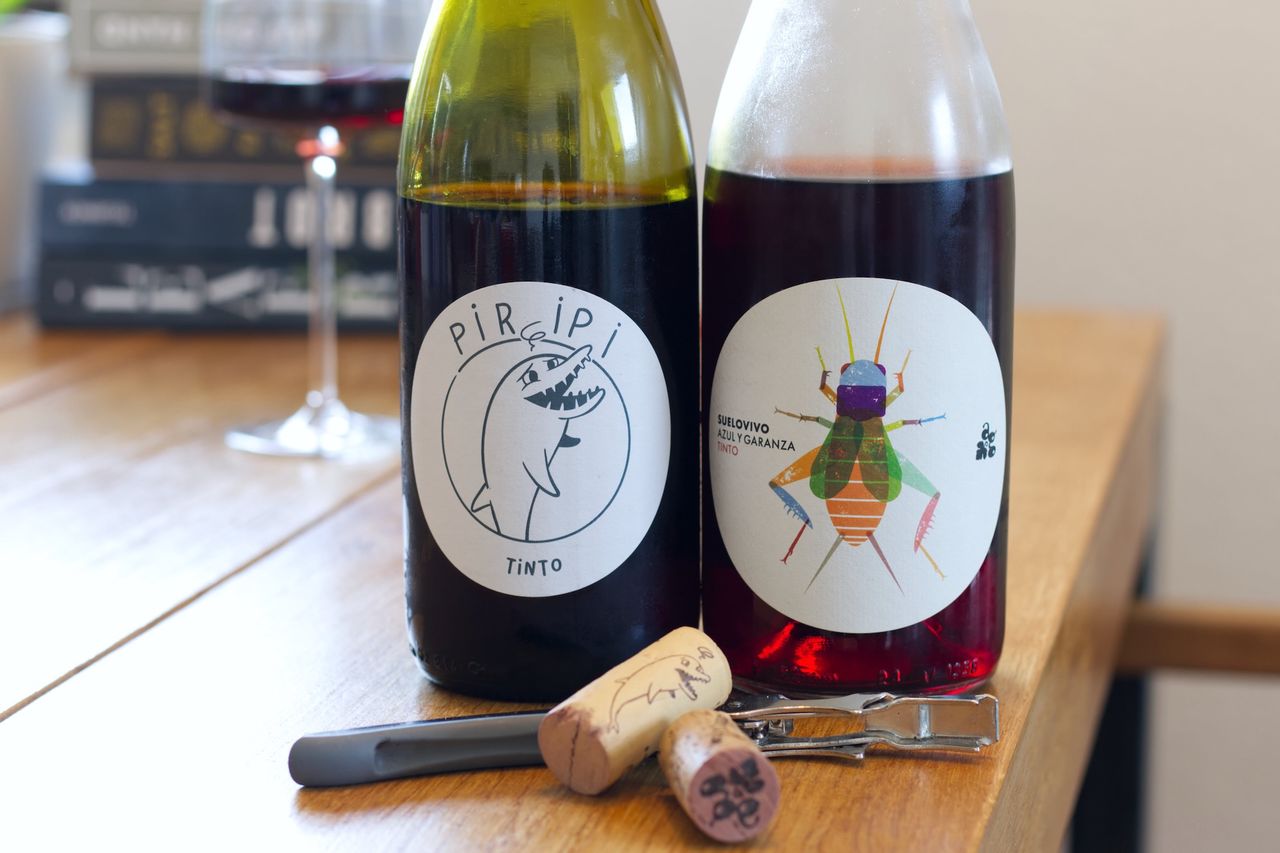
What happens when the better half orders podcast packages and “just quickly checks what else they have”, well, you can see it in this exhibit. Funnily painted dolphins make their way in. And what happens when I forget to photograph the back label, you can tell from the fact that the Piripi vintage is missing. Two pros at work in this household. Can’t be helped. Azul y Garanza, blue and madder red, okay carmine or purple-red, but to me it’s all the same, have been making wine on roughly 40 hectares since 1999 in Navarra in northern Spain. What feels like not all that long ago is by now over a quarter of a century. And once again it dawns on me how vast the wine world is, and how little of it I’ve actually covered, because at the keyword Navarra not a single drawer opens in my head. And that despite the fact that we already drink quite far off the beaten track. From the very beginning the vineyards have been farmed organically, back then still rather exotic, by now well into the mainstream. The vineyards and the winery building once belonged to a cooperative, somehow funny how things developed from there. The grapes are spontaneously fermented in concrete tanks, and they work in a minimally invasive way. The Piripi with the tipsy dolphin is single-varietal Tempranillo and, as already mentioned, I no longer know which vintage, because the bottle is gone and I didn’t take a picture. It’s natural, that much I know, and bottled without sulfur or filtration after spending two years in concrete tank. The Suelo Vivo, the grasshopper, is single-varietal Garnacha Tinto, also known as Grenache, which thanks to its color sits somewhere between a very dark rosé and a very pale red.
The Piripi is full of dark fruit, a few herbs, and a tiny bit of structure thrown in. There’s plum and bitter liqueur and even more than the nose I love how it feels when you slurp. Although it’s really hard for me to describe what it actually feels like when you slurp. It definitely does something to the wine on the tongue. The juiciness gains the exact right amount of fine tannin and at the same time becomes fruitier. Pomegranate is called out from across the table and that fits very well. This is delicious, even more delicious slightly chilled. cl
The fruit turns redder and riper overnight. Cherry, dark berries and a piece of chocolate. The tannin has almost vanished, the bitter liqueur likewise. It’s still very tasty, but unfortunately also somehow harmless today. The first evening had more punch to it and that’s what I’m missing today. A matter of taste, certainly, because nothing has fallen apart, it has simply become different.
The grasshopper we also chilled down. I don’t know, but somehow these light reds subconsciously drive me to the fridge. And it really was a good idea. This is basically chilled red fruit tea, a bit of tannin, red fruit, blueberries, dried cranberries and a slightly grainy spice on the tongue. This is the kind of wine where after three sips you don’t know how three sips could have emptied the glass, but once it’s empty, well, you simply pour another. This is summer wine, but one that also works under a skylight in full sun, as long as it’s still pleasantly cool outside.
A day later the wine remains chilled, homemade fruit tea with alcohol. That’s a dangerous mix, because alcohol, you don’t taste it at all, but you’ll feel it noticeably at some point. There’s depth there, the fruit shifts on the tongue, a bit of vanilla, a slightly woody structure, some spice. But really, really this is unfussy wine for big gulps. Saufwein. Really good and a candidate for reordering, so you can pull a bottle from the fridge even at 35 degrees. Maybe even with an ice cube. If you hide well enough, you’re allowed to do that once in a while. Nobody has to know.
Related Posts
- López de Heredia - Viña Tondonia Reserva 2007
- La Rioja Alta - Gran Reserva 904 2010
- Two Bottles Gaël Petit