Two Bottles La Grange de l'Oncle Charles
We're drinking two wines from Alsace by La Grange de l'Oncle Charles: Mille Lieux Blanc from 2024 and La Danse des Corbeaux from 2023.
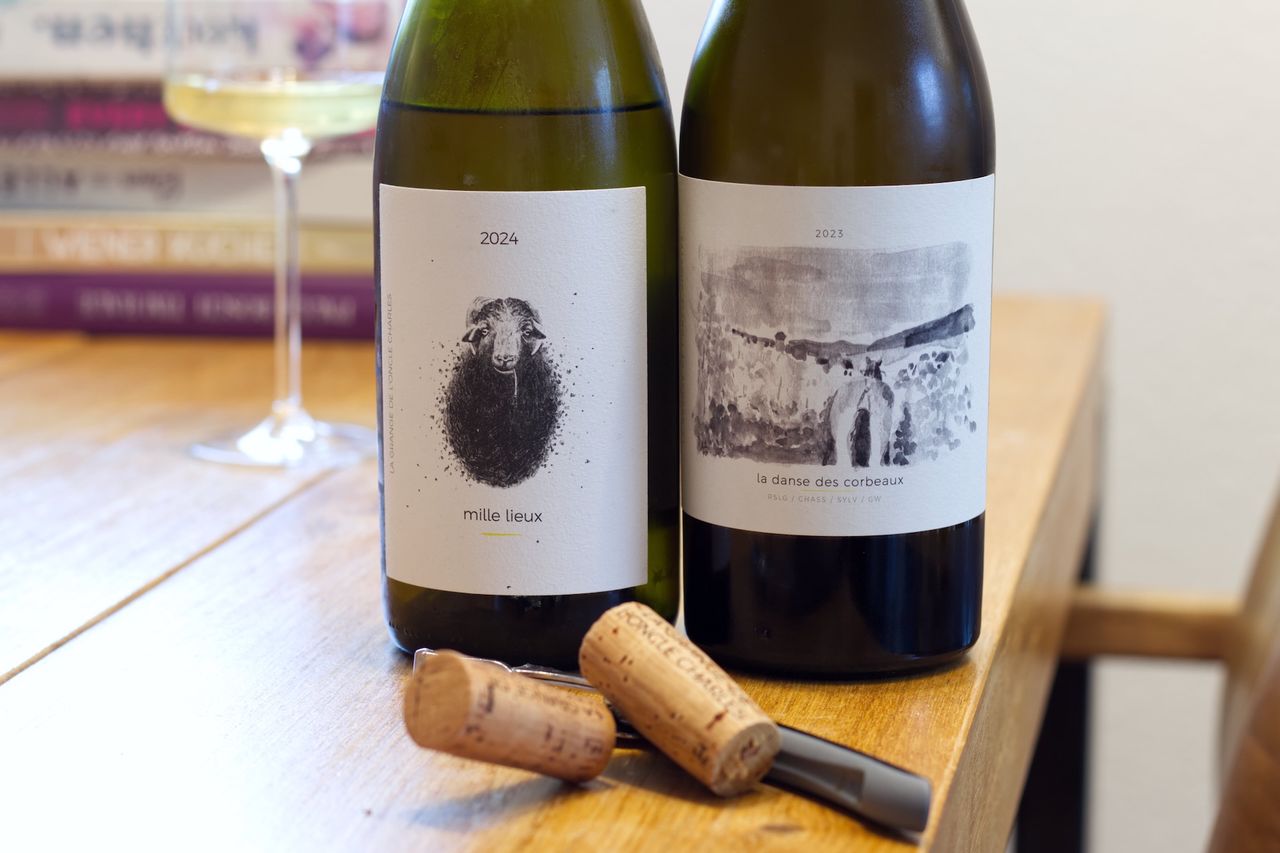
We had these for easter. But unfortunately, we can’t offer an Easter bunny on any of the bottles currently in our possession. But thematically we’re still well set up with the sheep, and we’ll just accept the horse’s behind on the bottle next to it. We didn’t buy the wine for Easter, of course. It drifted past me in Andreas’s feed, and after a brief glance across the table from the better half, on account of the animal label, it was filed into the “we need to have this” drawer. As gigantic a manure heap as social media has become, for discoveries like this, wading through the slurry is unfortunately worth it.
Jérôme François and Morgane Stoquert founded the La Grange de l’Oncle Charles estate in Ostheim in Alsace in 2014, and given the name, where else but in Uncle’s barn. They started out with plots from the grandfather, which have since grown to around seven hectares. You can see the estate’s most important employees on the labels. Two horses help with soil cultivation, a flock of Ouessant sheep takes care of the weeding and mulching. Many of the plots these helpers get their little legs under are planted as field blends, which is something of a rarity in Alsace. All the wines are fermented and aged in small wood and bottled without sulfur or filtration. We’re drinking the entry into the range, Mille Lieux, the one with the sheep, from the 2024 vintage. 13 grape varieties, that’s all the grape varieties grown at the estate, from various terroirs go into the wine. Not so easy, by the way, to find the complete list. In Alsace, according to Wiki at least, only seven grape varieties are permitted: Riesling, Gewürztraminer, Sylvaner, Pinot Blanc and Gris, Muscat d’Alsace and Pinot Noir. On top of that, Chasselas (i.e. Gutedel), Chardonnay and Savagnin Rose are listed. For anyone keeping count, that brings us to 10. Auxerrois turns up in further web searching, and that’s the lot. After a year of aging, the wine lands in the bottle at eleven and a half percent. La Danse des Corbeaux is the village wine from Riquewihr, which makes things considerably easier on the grape variety front, they’re printed right on the front. Riesling, Chasselas, Sylvaner and Gewürztraminer share the vineyard here, and the bottle.
We start with the sheep. It has lots of tension, a fruit somewhere between creamy yellow and crisp green apple, pulling a little in the other direction each time you smell it. There’s something herbaceous, something citrusy, something mealy and a dab of glue. On the palate, it’s all pull, taut, straight ahead, juicy in the middle of the tongue and with structure at the edges. With the wine in the mouth, the nose becomes sparer, more linear, and likewise takes on more pull. The creaminess disappears entirely and is replaced by spice and green apple. This is wonderful to drink and, in a really clean way, wild.
The next day is more natural. Never in your face, though. It stays subtle, quiet, unobtrusive. There are now oxidized apple skins, the apple overall is still there, but no longer green. The wine feels much softer on the palate, the structure that on the first evening only played out at the edges of the tongue now covers the whole palate. It’s long, has by now almost something sweet on the nose, which the other side of the table files as white gummy bears. Not for me, but I can well imagine that we’re filing the same impression into different drawers here. Where we don’t differ is the speed at which the glasses need refilling. This really is a lot of fun.
The one with the horse’s rear is noticeably wilder, more glue, puffed grain, has something of reductive Chardonnay about it for a few minutes. There’s barely any fruit, maybe a touch of citrus, a few grapes, lots of cool freshness. The acidity, on the other hand, is extremely fruity, there’s a whole bag of sour apple rings on the tongue. This has some real zing on the palate. What it doesn’t have is aromatic-varietal flair, and for me that’s a good thing. Slowly, some buttery pastry joins in, which I wouldn’t have expected there after the first moments. I had brief respect for the portion of glue and unruliness coming out of the glass at first, but either I drank myself into the glue or right through it. Or it simply disappeared. Because now there’s only the mix of fruity pull on the palate and grainy, citrusy, cool nose.
The next day starts with sherry on the nose. Less glue, but not no glue, the puffed grain feels much nuttier than on the first evening and certainly feeds into the sherry idea. And sherry not in the sense of a white wine that’s been opened and has obviously let too much oxygen through its cork, but sherry in the sense of genuinely good sherry. It drinks, by the way, unchanged. The acidity does its fruity zing, is very appley, today though with more core and skin. That there’s Riesling and Gewürztraminer in the wine, I wouldn’t have guessed. Sylvaner and Chasselas on the other hand, that fits very well with what you taste. This is just as exciting as on the first evening. A bit more intellectual, certainly, than the one with the sheep, less easy drinking, but no less good.