Two Bottles Fürst
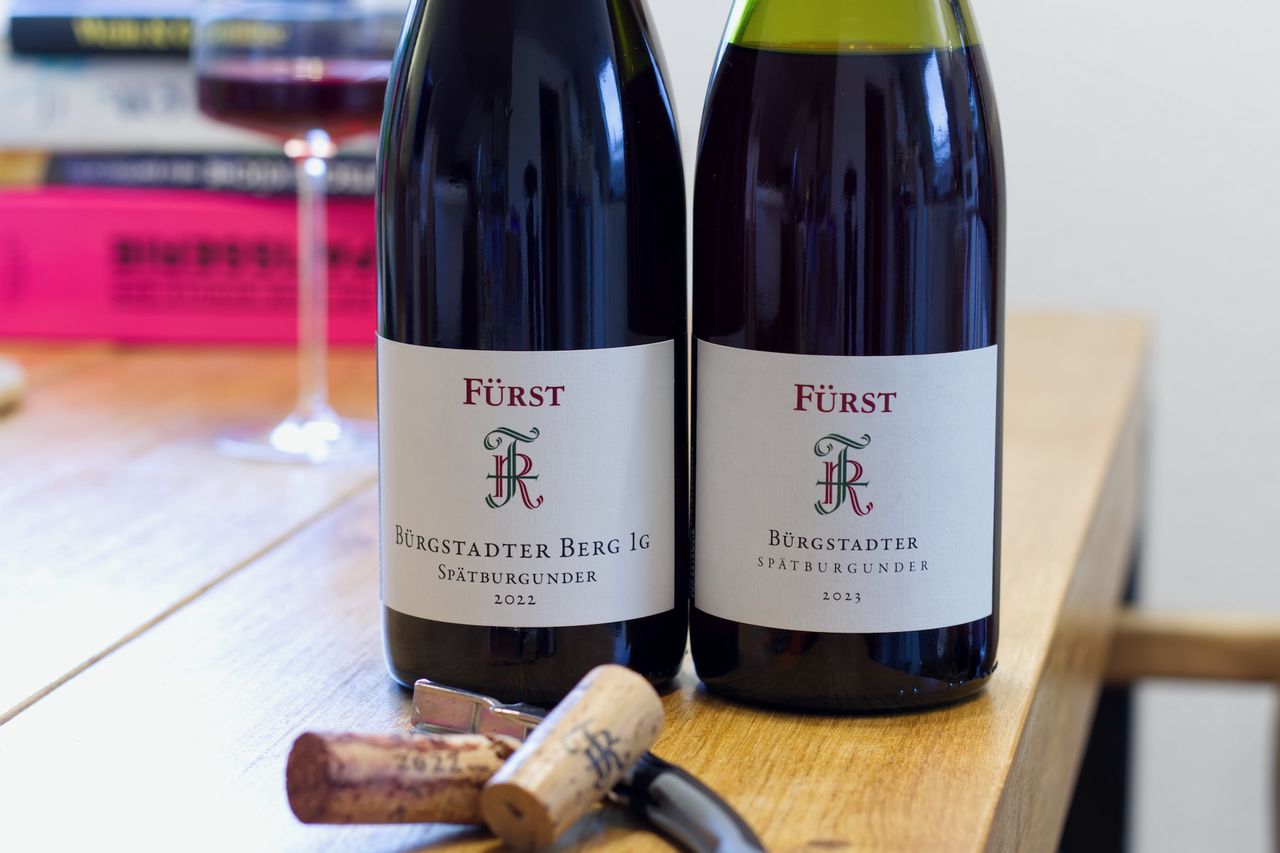
This week we're drinking two Spätburgunder from Franken from Weingut Fürst: a Bürgstadter Ortswein 2023 and an Erste Lage Bürgstadter Berg 2022.
Yet another winery I’d been wanting to try for quite a while. That’s why this week we’re once again drinking Spätburgunder from Germany. Franconia, to be precise, and specifically the red wine corner of Churfranken not far from Klingenberg am Main, from where we already had Pinots here on the blog. I have to note that was already quite a few years ago. One of the names that definitely has to be put on the table when the subject is Spätburgunder from Germany is Fürst. The Fürst family, in any case, can look back on a winemaking tradition dating to the 17th century. Rudolf Fürst, who lends his name to the present-day estate, had a mixed farm, as used to be more the rule than the exception, in Bürgstadt am Main. In 1979 Paul and Monika Fürst take over the estate and build new buildings directly into the Centgrafenberg, which to this day is the site most readily associated with Fürst. In 2007 their son Sebastian joins after studying in Geisenheim, and the potentially next generation is already waiting in the wings. And Pinot, too, has played an important role at the estate for a long time. Around Bürgstadt it grows primarily on Buntsandstein. A few sites are found opposite the town on the other side of the Main, the ones with the big names, Centgrafenberg and Hundsrück, stretch eastward along the tributary Erf, with the slopes facing directly south.
Today we’re trying a village wine from Bürgstadt from 2023 and an Erste Lage from the Bürgstadter Berg from 2022. At Fürst this is essentially the second wine behind the two aforementioned great sites, made from grapes from the great sites that didn’t make it into the top wines. Both wines are made in a style fermented spontaneously in wooden vats, in which some of the grapes remain whole, so that you get a bit of a mixture of classic fermentation and maceration carbonique. In the village wine it’s a little under a third whole clusters, in the Erste Lage around 60%. They are then matured in a mix of old and new barriques.
We start with the village wine, and for a few moments it starts out extremely austere. But with every hour in the air the wine opens up. The fruit becomes fruitier, the wood woodier, and the spice spicier. It’s extremely exciting to watch, or rather to smell. There is marzipan, a little vanilla, and a cool, very cherry-like fruit that is really enjoyable. But the time in the air was more than necessary for the aroma. Best to open it at lunchtime if you want to drink it in the evening. It has grip, texture from the middle all the way out to the edge of the tongue, where it simply remains. The acidity is fresh and cool, just as the fruit on the nose already is, and with the wine in the mouth it becomes more and more charming on the nose.
On the second evening both wines have to make do with different glasses. We’re on the road and although we tucked the wines under our arms, we left the glasses at home. It is less fruity on the second day, cooler, spicier. There is fresh wood, very little cherry and stone. It still has plenty of drive, and the vanilla is still there too. It’s juicy and somehow simply delicious. The more you slurp, the more the tannin grabs hold. And then not just the tongue, but simply the whole mouth. An interactive red wine, so to speak, whose tannic structural experience you can adjust yourself while drinking through very socially acceptable slurping. Fun for everyone at the table.
In contrast to the village wine, the Erste Lage cannot quite shake off that sense of distance even after a few hours in the open bottle. It is finer, quieter, and yet denser and perhaps simply more precise than the village wine. In any case it feels more serious. Less fruit, a large portion of etherealness that I don’t find at all in the village wine, more marzipan, no vanilla, and still a good portion of wood. I find this a truly great pairing of Erste Lage and village wine, even if they are not from the same vintage. You so strongly get the sense that here, on the same foundation, one more storey has simply been built upward. This extra dark depth makes you stick your nose into the glass one more time. The spice that grips the tongue a little differently each time, the structure, the finesse in the fruit. This is, without doubt, the greater wine. But the wine for the next big gulp, that is the Bürgstadter.
In fact, a day helps. Now there is blackberry bush, although no, there is blackcurrant wood. We had that at Etz in the non-alcoholic drink pairing, preserved in sugar. We learned that some blackcurrants smell in the wood and some do not. And we are lucky: the one in the garden does smell, and every spring plenty of cuttings accumulate anyway because old shoots are removed completely. So we ourselves simmered a few cuttings in sugar and let them steep. And that is exactly what this smells like in the wine. Always helpful when what the subconscious suggests can also be pulled out of the drawer, or here the refrigerator, in real life. And then actually compared. The wine has more tannin today, velvety, but already with power, and a little more cherry. I stand by it: if you want to compare village wine with Erste Lage, this is a combination that depicts exactly what that comparison ought to offer. And today, on this second evening, this bottle too is one for big gulps. And that extra storey really is worth it. It simply needs a little more time to get going.
Related Posts
- Two Bottles Rudolf May
- Three Bottles Weingut Am Stein
- Richard Östreicher - Spätburgunder Tradition 2016