Two Bottles Wachter-Wiesler
To kick off a small Austrian series, we're drinking from Weingut Wachter-Wiesler a rosé Handgemenge 2024 and a Blaufränkisch Eisenberg 2022.
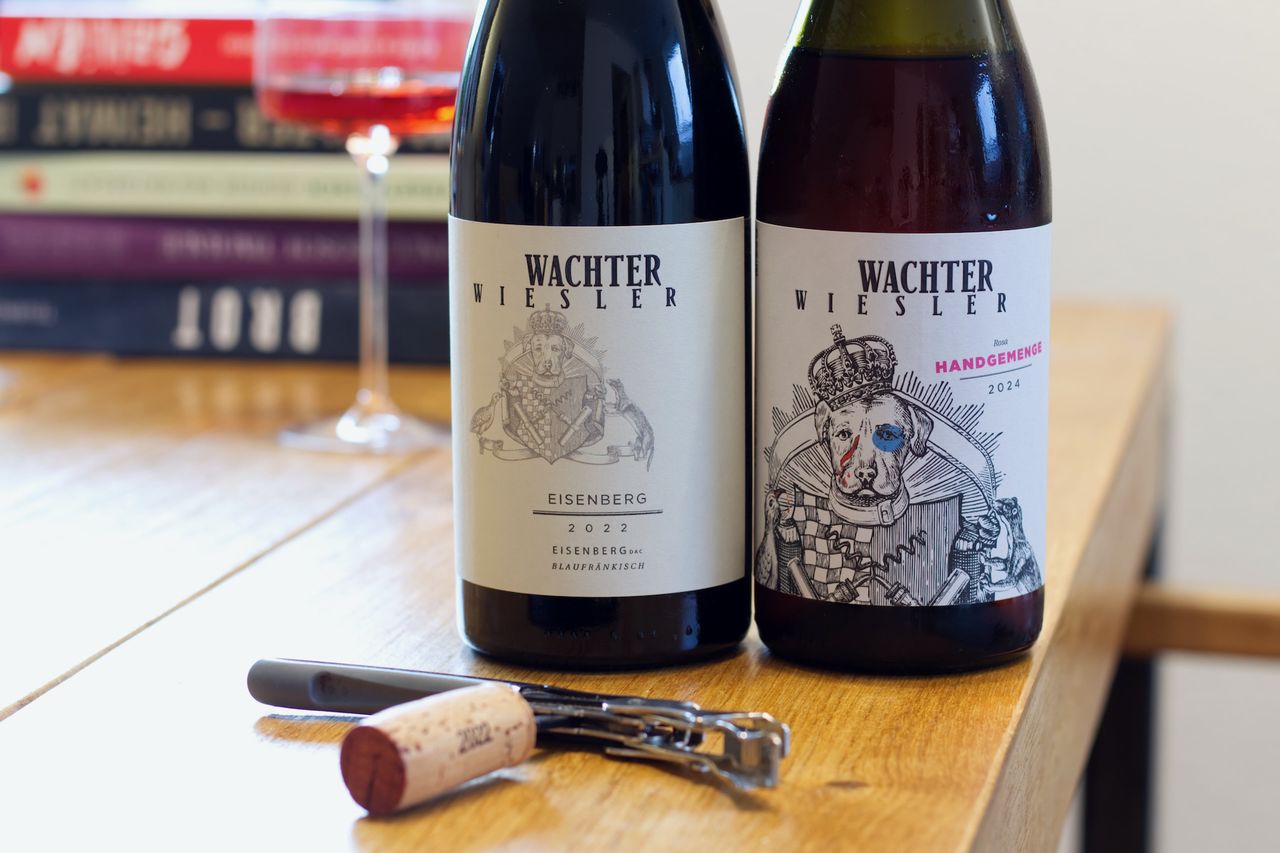
Drinking thematically connected wines is the nicest way to drink. At least I think so. Not so much because of whatever insight you might hope to gain, but because you ease into it so nicely, and when you then find a connection, a line, a unifying element, you’re all the more pleased, and if not, then it doesn’t matter either. At the last round of SchmelzPerlage&Bodensatz, Jakob Schönberger from Burgenland was in Karlsruhe, and I thought that drinking a bit more Austria has been on my list for a while now. After all, we only had a single bottle from there the entire last year. So why not now, since Blaufränkisch is close to the inner Swabian’s heart anyway. Even if the inner Swabian calls it Lemberger, of course. And the arc from Karlsruhe to today’s bottles couldn’t be easier to draw, because Wachter-Wiesler also makes wine in Burgenland, likewise on the Hungarian border, though a good bit south of Lake Neusiedl, on the Eisenberg. Oh yes, and you even get an animal label as a bonus.
The winery itself hasn’t been around that long, only in 1999 did Béla Wachter and Jòska Wiesler merge their separate estates. On the other hand, 1999, which sounds like yesterday, was also 27 years ago by now. Shit, I’m getting older. In 2008, siblings Christoph and Julia Wachter took the helm. They converted to organic in 2015, certified since 2018. The goal from the beginning was to make great, origin-driven wines from the Eisenberg. That now happens on 16 hectares of vines. The wines are hand-harvested, spontaneously fermented, and then slowly matured in large oak. Or, in the case of the pink Handgemenge, partly in stainless steel. Handgemenge is the slightly wild entry into the estate’s wines, in the pink version it’s a cuvée of Blaufränkisch, Merlot, and Zweigelt. We’re also drinking a varietal Blaufränkisch Eisenberg DAC, a village wine from the mid-tier of the quality pyramid.
We start with the Handgemenge. This is rosé the way I like to drink rosé. It stinks a bit, no, actually, it has a whopping stinker, with squashed berries, cap-gun reduction, and a wild note behind it. Somehow, even on the nose it already feels more like a light red wine. In color too, by the way, which you can see quite well in the background of the photo. It’s enormously juicy, cool, and fresh on the palate. Rather tart berries, a slightly creamy fruit, a few strawberries in there. Straightforward, I’d say, provided a wine with such a stinker can be straightforward. Probably depends on the drinker. Maybe it would fit summer even better than early spring, but it’s fun even now.
Overnight it loses its edge. It’s creamier, darker in fruit, and a bit more spicy on the tongue. It’s become one idea more of a light red wine. Not that I’d complain about that in any way. On the contrary, this way it fits the cold weather even better. Everything has moved closer together, the wildness remains but feels less direct. So if you struggle right after opening, you can absolutely try giving it a lot of air. Maybe that helps. I liked both evenings about equally. And for a bit over 10 euros, there’s no reason to complain anyway.
The Eisenberg briefly recalls an effervescent tablet. Only briefly, really. Then follows an intense mix of spicy wood and an interplay of dark cherries and blackberry. There’s something ethereal, somewhere at the other end of the table there’s also an open bottle of Uhu glue. Just enough that you notice it, not disturbing. This is terrific from the very first sniff. Fortunately, the flavor can keep up. The tannin grips the tip of the tongue up front, then comes loads of fruit, so much that you briefly think of sweet dessert. The vanilla certainly helps there. But then there’s so much vanilla that it dries out the middle of the tongue until the next sip brings cherries and berries again. How anyone can’t celebrate Blaufränkisch, or Lemberger, I will never understand. This is serious, deep, complex, and at the same time so juicy that even big gulps don’t feel big enough.
And this wine, too, turns darker overnight. Wilder somehow, and more spicy. The fruit is no longer quite as intense, no longer so sweet. Instead it now has blackberry leaves, charming brush, and wormwood. The tannin that was gripping yesterday has melted away. The wine almost feels creamy by now, long, and only right at the very back does the fruity acidity join in. And the vanilla has also been replaced by herbs and a bit of bitter liqueur. It’s still fruity on the palate, but today not because you taste berries, rather because the acidity so strongly reminds you of fruit juice. Fascinating how different the wine is today. Which I like better? Difficult. Sure, there’s more depth now, more to discover, but the fruit on the first evening was also very, very lovely. And as with the pink Handgemenge, I don’t want to have to commit to which evening tastes better. What I will commit to, though, is that this is a really successful start to this series.
Related Posts
- Two Bottles Von Der Vogelwaide
- Moric - Lutzmannsburg Ried Kirchberg 2019
- Two Bottles Albrecht Schwegler