Two Bottles Bründlmayer
We are drinking from Bründlmayer from the Kamptal a bottle of Sekt Reserve Brut and a Grüner Veltliner from the Ried Berg Vogelsang 2023.
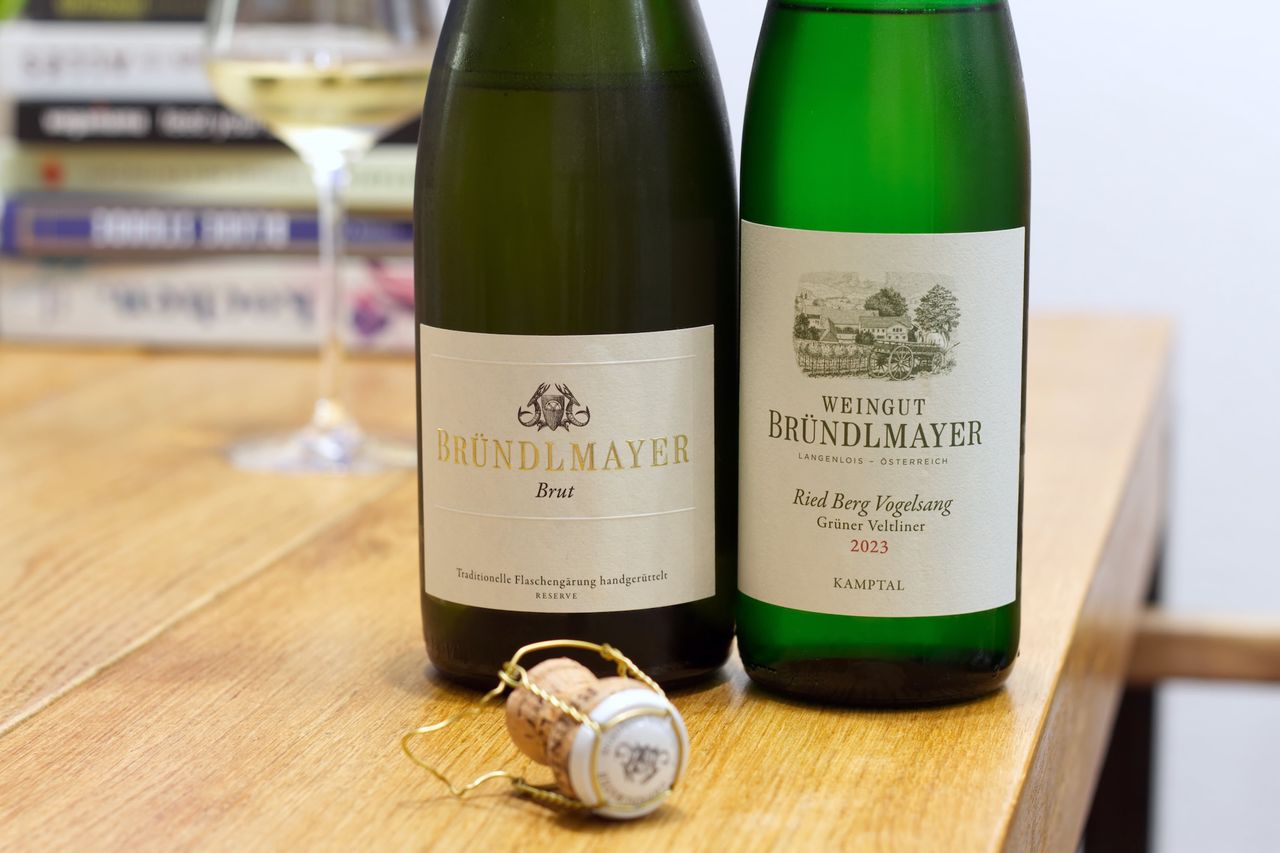
We had this sparkling on an election sunday. If thats appropriate, everyone has to decide on their own I guess. I’m fundamentally of the opinion that sparkling wine basically always and everywhere works. And bubbly from Austria would probably deserve a whole separate series anyway. Noted for the future, but you have to start somewhere. Today we’re starting in the Kamptal. Geographically, the Kamptal lies downstream of the Wachau, directly after the Kremstal wine-growing area, in the Weinland wine region northwest of Vienna. As the name suggests, the river Kamp flows through the Kamptal, just as the Krems flows through the Kremstal, but not the Wach through the Wachau. That would be too easy. On the three and a half thousand hectares of vineyards here, white grapes are planted by a huge margin, and among those, by an equally huge margin, Grüner Veltliner. In Langenlois on the Kamp lies Weingut Bründlmayer. Funny enough, Bründlmayer is the name that pops into my head first when it comes to Austrian sparkling wine, even though before this bottle I had tasted exactly zero Sekts from this winery. To be fair, Bründlmayer and “the ones with the bottles that look like they’ve been amusingly squished, whose name I can’t think of right now”, which would be Harkamp. But enough insight into my susceptibility patterns for marketing. As I said, a deep dive into Austrian bubbly is on the cards at some point.
The Brut Reserve, as I see it the entry point into the sparkling wine range, is a cuvée of Spätburgunder, Chardonnay, Grauburgunder, Weißburgunder and Grüner Veltliner. They’ve gone right across the grape-variety portfolio. Also included are reserve wines back to the 2014 vintage, which make up just under half of the cuvée. It then spends three years on the bottle before it goes on sale. That also explains why even at the entry level you have to put around 30 euros on the table. The grapes for the Grüner Veltliner grow in the Ried Berg Vogelsang, Kamptal, but on the map actually somewhere between the Krems and the Kamp, looking southwest. The vines here grow on mica schist on a slope, are aged in steel and large oak, and then taken to bottle.
The Sekt smells of brioche, of yellow fruit that’s rather restrained but definitely ripe, a bit stony, and a bit like buttery pastry. From the first sip it comes across as very dry, but at the same time much more fruit-driven than the nose suggests. At least in the way the acidity feels, not so much in terms of discernible fruit. But it simply has this fruit-juice acidity that immediately makes you think of fruit. This is dense, intense on the palate, and long. I at least wouldn’t think for a second that there isn’t a traditional grape blend in the glass, and to land on Grüner Veltliner is probably close to impossible. Sparkling wine is incredibly hard to gauge anyway, I find. Even Riesling Sekt I sometimes file into the non-Riesling-Sekt drawer, and that’s actually relatively straightforward if you disregard outliers like Muskateller. Then trying to pick out a proportion of Grauburgunder or Veltliner here, good luck. Doesn’t matter, because in any case this is really, really good.
The Veltliner has nothing but spice in the first moment. There are herbs, there’s something vegetal that’s on the tip of my tongue, but once again I can’t quite place it. Then the better half says dandelion, and I think that hits it very well. Herbaceous and somehow floral. Behind that a little fruit, a few apple rings, those from the sweets aisle, not the ones from nature, and a mix of creaminess, acidity, and a touch of bitter spice far back on the tongue. Whether that’s the Pfefferl, I don’t think so. And with the Veltliner in my mouth I reach again for the sparkling wine glass, and no, I still wouldn’t be able to smell it out. This isn’t an intrusive wine, and once again we’re relatively early with the corkscrew. Maybe that’s why it still can’t quite come out of its shell.
But practically nothing changes overnight. When it comes to aging potential, that’s often a good sign. When I read through what I noted down, I could write it all again the same way today. 2023 is simply still very fresh and may need a run-up. In any case it’s still a structural wine, because fruit is in short supply. It feels a touch more herbal, the dandelion is gone. Some pome fruit behind it instead. In terms of flavor I’m on my own today, because although my fellow drinker is (of course) drinking along, she’s slightly under the weather, and my own experience with cold eucalyptus gel capsules is that from about 20 minutes after taking them, the following hours become a special experience. Every burp a cold bath. That massively reduces my confidence in the flavor impressions flying at me. With lots of slurping the Veltliner is very appley now, and it actually no longer seems quite so closed in on itself. Overall this reads much more critical than I really am, because I actually like this a lot, it just needs a bit more time.