Knoll - Ried Kreutles Smaragd Grüner Veltliner 2024
This week we are drinking a bottle of Ried Kreutles Smaragd Grüner Veltliner 2024 from Weingut Knoll in the Wachau.
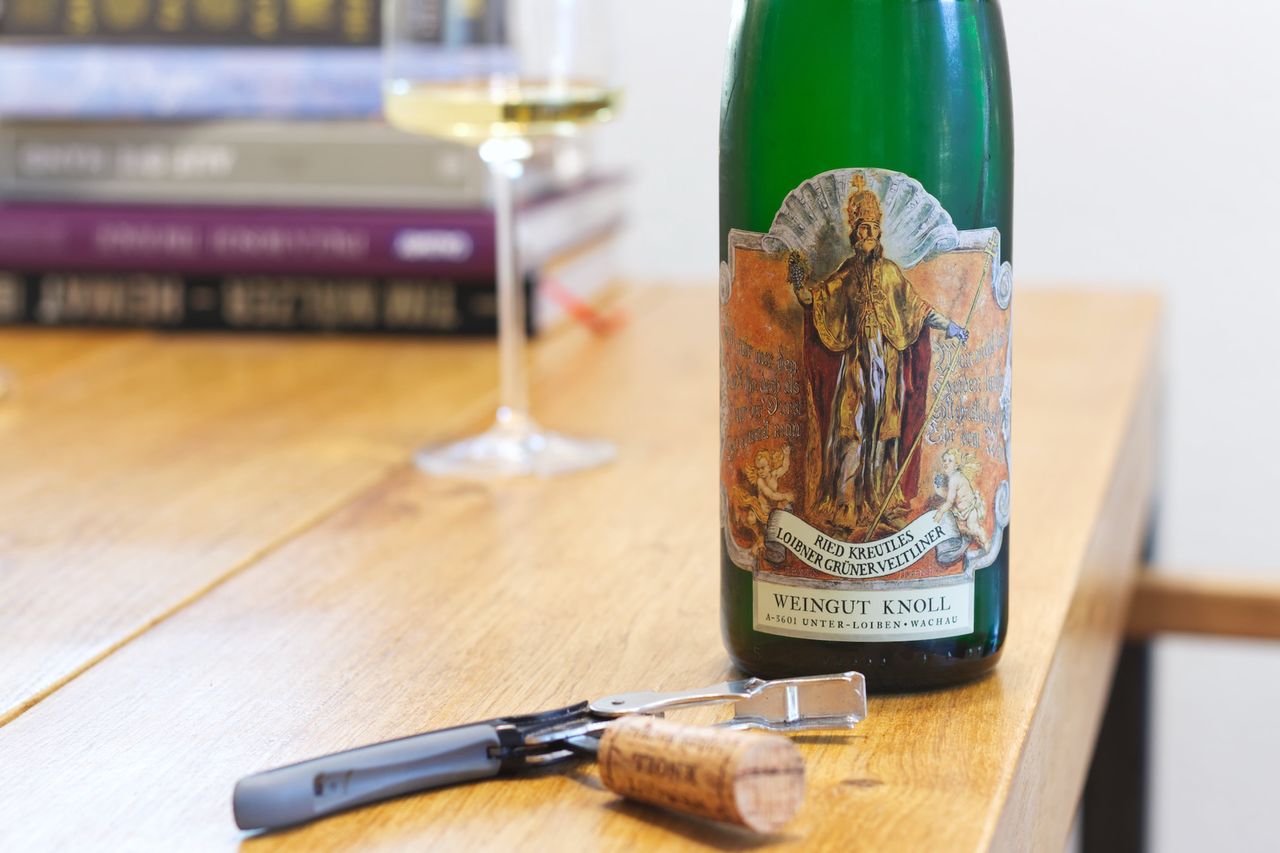
We have to bring up two topics right at the beginning. Yes, Smaragd wines can be laid down for a long time, yes, 2024 was obviously not laid down particularly long. But we’re drinking the wine over three evenings and, generally speaking, I don’t see any particular problem there. Then the label. Every time I see one of the Knoll bottles, I ask myself whether I find it really great or really terrible. And the mere fact that I’ve still been asking myself that question for years is somehow fascinating. I’m not a marketing guy, quite the opposite: in my working life I do a lot to keep plenty of space between myself and marketing and/or sales projects. As a buffer zone for peace of mind. But that also means my judgment of labels is based solely on my personal opinion, and to make matters worse, a sample size of one is a very small sample. Two, actually, but the person opposite thinks the label is terrible, and always has. But even she has to admit that in an inn, even in half-shadow and with nine tables’ distance between them, you can reliably recognize a Knoll bottle on the shelf board at the other end of the room. When I think of wine from Austria, this is the label that comes to mind. And that is even more fascinating, actually. Quite a lot done right, I’d say.
The fellow on the bottle is Saint Urban, patron saint of winemakers. And thus also patron saint of the Knoll family, who by now farm around 16 hectares in the Wachau, mainly with Riesling and Grüner Veltliner. Modern stuff like their own homepage? What for? A picture of Saint Urban and a link to the winery entry at Vinea Wachau do the job too. Consistent, somehow. Vinea Wachau, an association of estates from the Wachau, is also the body responsible for the classifications Steinfeder, Federspiel, and Smaragd, which primarily tell you something about the style of the wine. Smaragd therefore means complex and long-lived, at least twelve and a half percent, and without wood. The grapes for this bottle grow in the Ried Kreutles at the foot of the Loibenberg on loess soil with a view of the Danube.
Right after opening, the wine still smells quite yeasty. Maybe we were too curious. But we have time. The fruit behind it is creamy, rather restrained, and not really easy to place. There’s something floral, a bit of dextrose, a bit of pome fruit. The first sip seems harmless, but it’s deceptive. This is long, creamy, and salty on the finish. A wine that builds slowly, that has structure without the structure barging straight into the house, or onto the tongue. It’s soft and gripping at the same time, and in that way escapes description. Almost viscous, the Veltliner then sits around in the mouth and at the same time has real tension. Now a Wiener Schnitzel. That would be it. Maybe also because the Kreutles Federspiel from Knoll we had in Freiburg matched exactly such a schnitzel wonderfully.
But unfortunately there was no schnitzel this week. Instead, a second evening with the wine. Even on this evening, the longing for a flat-pounded rag of veal in fine breading with Erdäpfelsalat doesn’t really let go of me, but what can you do. The wine smells exactly like on the first evening, just without the yeasty start. A bit more of everything, perhaps. More grape, more floral, more aroma. And again, the first sip starts quietly and then builds. The mouthfeel is terrific, the oily quality is there, at the edges of the tongue, pear and yellow, very ripe apple, and although the wine feels really young, it never feels unfinished. It works like this. But we’ll treat ourselves to a third evening.
The texture gets another notch better. This lives entirely from how it feels. Normally, structured wine often comes via something pithy, something this Veltliner doesn’t have at all. And yet it’s structured wine. That three evenings aren’t time for such a Smaragd is merely a comforting side note. A few years in the cellar, quite a few years in the cellar, it won’t be. But pulling the cork wasn’t wrong either. Because it’s already really good. Maybe I’ll come across a mature one someday.