Two Bottles Schnitz und Butzen
We are drinking from Schnitz und Butzen a Cuvée of quince and Spätburgunder from 2023 and an apple plus pear Cuvée Ochsenäcker from 2021.
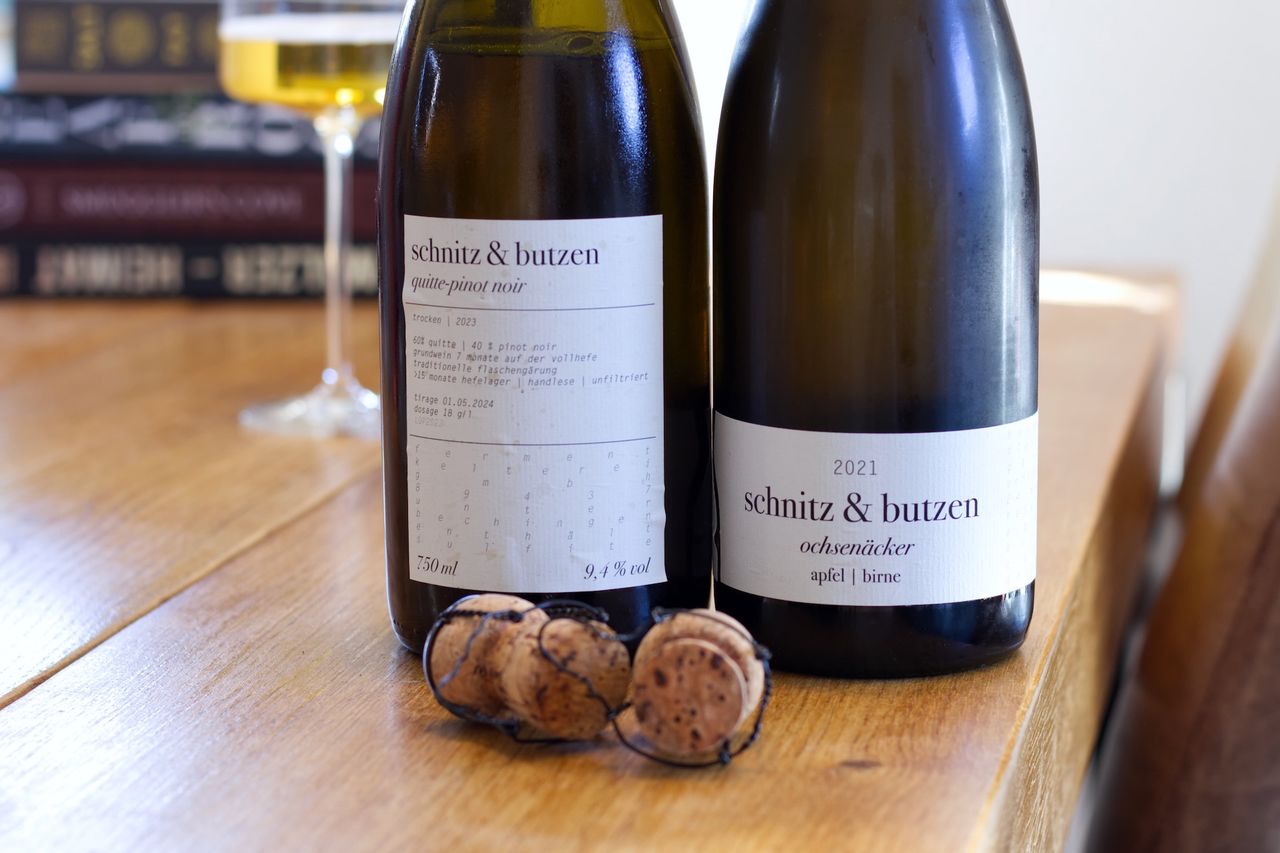
January has basically just ended, and what could be more suitable for a seamless transition from orchard fruit to grapes than a combination of the two in one bottle. Exactly: nothing at all, and that’s exactly why this week we’re drinking two bottles from Schnitz und Butzen. I consider Schnitz und Butzen to be the best name anyone could come up with for a company processing orchard fruit, its hard to translate though, something like slice and core I guess, and every time their drinks cross my path somewhere, I’m delighted. So it’s long overdue that they show up here as well. For his fruit sparklers, Peter Baumgartner uses orchard fruit from meadows within a 30-kilometre radius around Unterbechingen near the Danube. The motivation for doing so aligns with many of the other producers we’ve been drinking over the past weeks: to utilise the fruit, add value, and give orchard meadows a future. Ochsenäcker is made from fruit from the eponymous house site near the cellar. Roughly equal parts apple and pear from different varieties go into the cuvée. First, the base wine is aged on full lees before the fruit sparkling wine is then allowed to mature for another two years on the lees in a second fermentation in bottle. Méthode Traditionelle. It is dosed with 11 grams of residual sugar and disgorged by hand. Quince and Pinot consists, as the name suggests, of 60% quince and 40% Pinot Noir grapes. From the informative label you can then gather that this combination spends 7 months on full lees and then at least another 15 months in bottle before, after removing the lees, 18 grams of sugar per litre are dosed.
I have low expectations when it comes to bottles with quince. Not about the taste, of course, that has to hit, but about the opening experience. Because of its tannins or haze-forming compounds, quince tends to behave very aggressively when removing the closure. Meaning: quince likes to explode right in your face. That’s why quince is always, categorically and without exception, opened outside. In hindsight it wouldn’t have been necessary here, but better safe than sorry, and I’d rather freeze outside for a moment than wipe liquid fruit off the wall. Greetings at this point to Von Wiesen.
It smells of quince jelly, actually almost exclusively of really good quince jelly at first. Quince can sometimes veer towards bathwater, nothing that would bother me, but here you don’t get that at all. If you didn’t know there’s Pinot in it, you wouldn’t smell it at this stage. Behind the quince there’s then a bit of traditional Pinot sparkling, more the feeling you get when smelling than the actual aroma. The first sip then briefly reminds me of pink Ahoi sherbet powder, unexpected, but actually pretty spot on. It has drive, is enormously taut, with really great, intense fizz. Time in bottle ageing simply can’t be replaced by anything. And funnily enough, the drinking feel is the complete opposite of the nose. Here it’s far more sparkling than quince, which only slowly lingers on the back of the tongue. That’s great, even if it isn’t as low in alcohol as most of the other fruit sparklers from recent weeks. Grapes simply have a lot of sugar, even if only 40% of them make it into the bottle.
With more time towards the end of the evening, the two worlds converge. The nose becomes more Pinot, the taste more quince. What remains is how good this is. I really hope products like this lead to more quince being planted and that the quince that does exist doesn’t have to live only as jelly. There’s so much potential in it, and most people probably don’t even realise how good a quince sparkling wine can actually be.
Next up is Ochsenäcker. It has a bit of smoke on the nose and at first reminds me more of ham than of cider. There’s oxidised apple peel, stewed pear, that too including peel and core. But the longer you breathe in, the more fruit you smell and the less smoke remains. A bit of swirling has a very similar effect, with the bonus that you don’t look like an idiot sucking air in at the wine glass. And the fizz survives the spin in the glass without complaint. It tastes very similar to how it smells. A little smoke, a little structure, and a lovely, very fruity acidity that takes over the tongue from the back. It stays that way throughout the evening. Now it smells more of apple peel and somehow significantly riper than it tastes. I like that, but against the quince–Pinot mélange it draws the shorter straw so dramatically that we put half the bottle in the fridge overnight.
That turns out to be a really good idea the next day. There’s more fruit, it’s softer, rounder, a little sweet now. There’s honey, structure, and overall simply much more clarity, both in the fruit and in the overall impression. Whether that’s due to the direct comparison or whether Ochsenäcker simply needed the extra air and time, I don’t know. But today it’s just as good as the quince was yesterday.