Two Bottles Perry by Kertelreiter
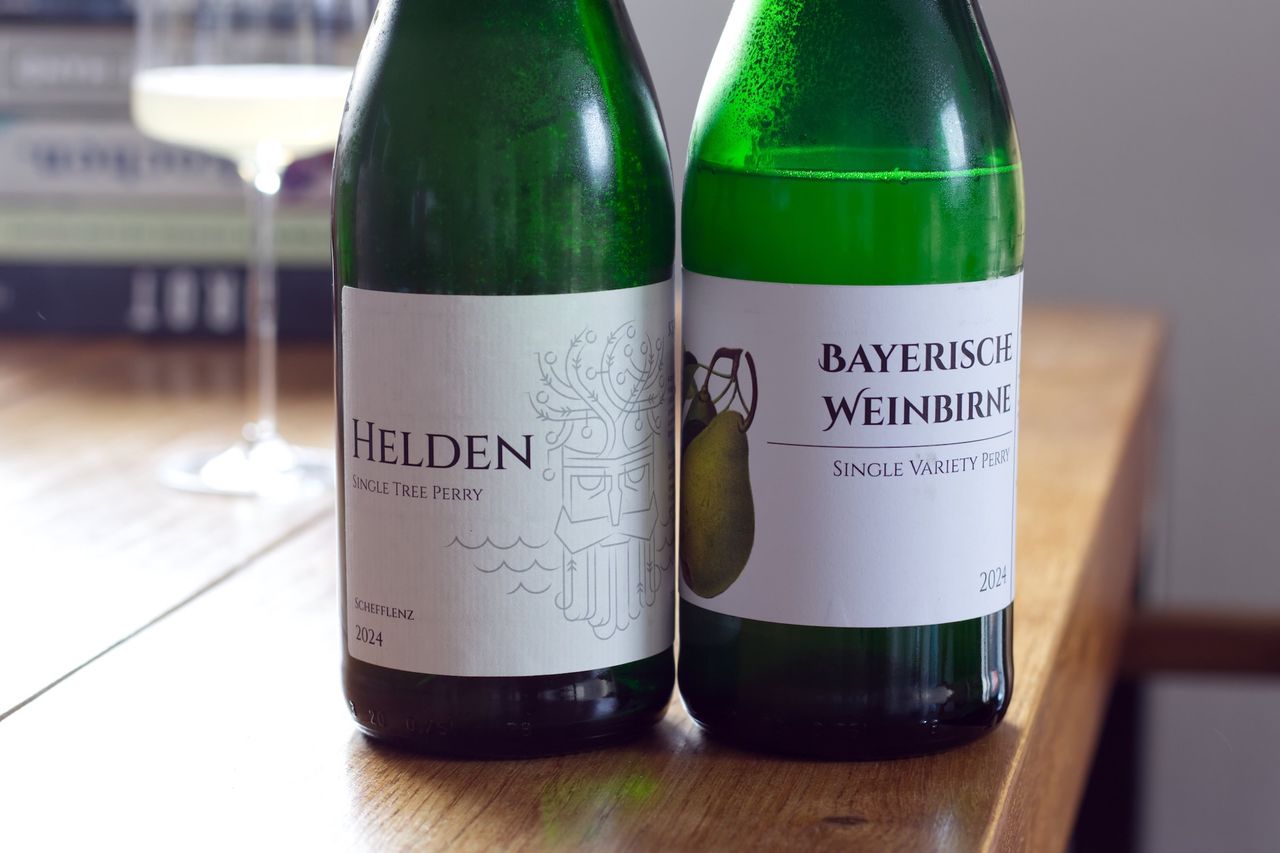
To conclude the small Streuobst series, we're drinking two bottles of Perry from Kertelreiter: a Bayerische Weinbirne 2024 and a Helden 2024.
If anyone is wondering whether I can read a calendar. Yes, I can. February, I know. But we still have to wait a bit for grapes, because we’re slotting a pear tree in between. Literally. If the credo is: the tighter the origin, the better, then today there’s only one conclusion. A single tree is then, inevitably, not just the pinnacle of that, no, it’s the topmost stone of the little cairn someone has lovingly piled up on the tip of the summit cross. The very top, tiniest pebble. Closest to the sky. Because it doesn’t get any tighter than that. If origin is everything, then everything has been wrung out here. A single tree. And setting aside all debate about whether orchard fruit benefits from varietal purity, what “site” even means in the context of a fruit tree, the fact that what’s in the bottle grew on a single, very large and very ancient pear tree. All that remains is fascination.
We had Kertelreiter in the glass already almost exactly a year ago, and there was already enough background information then, which is why I’m skipping a repeat of the explanation this year. But because it wasn’t that long ago, these two bottles actually weren’t planned again. But Single Tree Perry, the temptation was simply too great. Helden grows, as has been emphasized often enough by now, on a single tree, around 150 years old, of the Karcherbirne variety. That it’s Karcherbirne hasn’t been clear for that long. I think last year the Kertelreiter homepage still said “unknown pear variety”. There are 242 bottles of it. And because it’s hard to stand on just one bottle, we’re also drinking a bottle of Bayerische Weinbirne 2024. Like the Palmisch a few weeks ago, this is also educational future-drinking, because this variety is on this year’s tree-planting to-do list. The reason is the (very large) fruit size, which will make harvesting noticeably easier someday, and the fact that, unlike many other perry pears, it can also be eaten just as is. Only 61 bottles of this perry exist.
In the glass, the Weinbirne is a fairly cloudy brew. Unfiltered, very pale in color. The perry holds back a bit on the nose, is restrained, and in contrast to the color very clear in the fruit, very pear-forward. A bit like pears preserved in a jar: light, with a slightly pippy note behind it. And that’s how it tastes too: focused, clear, with plenty of drive and only a little tannin. A bit of core perhaps at the back of the tongue, but then washed away by acidity and fruit. It pulls at the cheeks and the tip of the tongue, draws your saliva toward the mouth, and when you have it like that in your mouth, it also smells distinctly fruitier and more pippy.
We’re eating leftover smoked fish, trout, salmon trout, Arctic char, from the neighboring village with a few slices of olive bread. My piece, of course, with pit. Classic. Eating as a borderline experience between choking on the bones and breaking a tooth on an olive pit. But the perry fits perfectly and stands up to fat, smoke, and aroma completely without trouble.
Even without drinking, you notice how much darker Helden is in the glass. And not only in color, also when you smell it. There’s a bit of slightly oxidized pear, forest honey, a few red berries, dried apple rings with peel, and also something herbaceous-vegetal, hay-like. The acidity sits somewhere between lactic and fruit juice and pulls even more saliva out of your cheeks than the Weinbirne already did. The tannin is much pippier, and also simply more of it, more structured. The fruit and acidity linger longer, are more powerful, more intense. The length is impressive, the aromatic depth too. You can taste the herbaceous-vegetal character, the dried fruit slices, and the red note as well. If it were wine, I’d call it a structure wine, because you inevitably start chewing on the perry. In direct comparison that may even be a bit demanding, certainly more intellectual, more challenging compared to the Weinbirne. You’re rewarded if you accept the challenge. And then it depends a bit on the occasion which bottle you reach for. If I want to be occupied for the evening, then I drink Helden, if I want to fix the wine evening after midnight, drink bubbles at 35 degrees in the sun, or accompany a Vesper, then maybe rather the Weinbirne. Or simply both. Because why be stingy.