Two Bottles De Moor
We kick off the wine year with two wines from Burgundy. From Alice and Olivier de Moor we're drinking a Chardonnay Bel-Air et Clardy 2020 and, from bought grapes, a Vendangeur Masqué Rouge 2020.
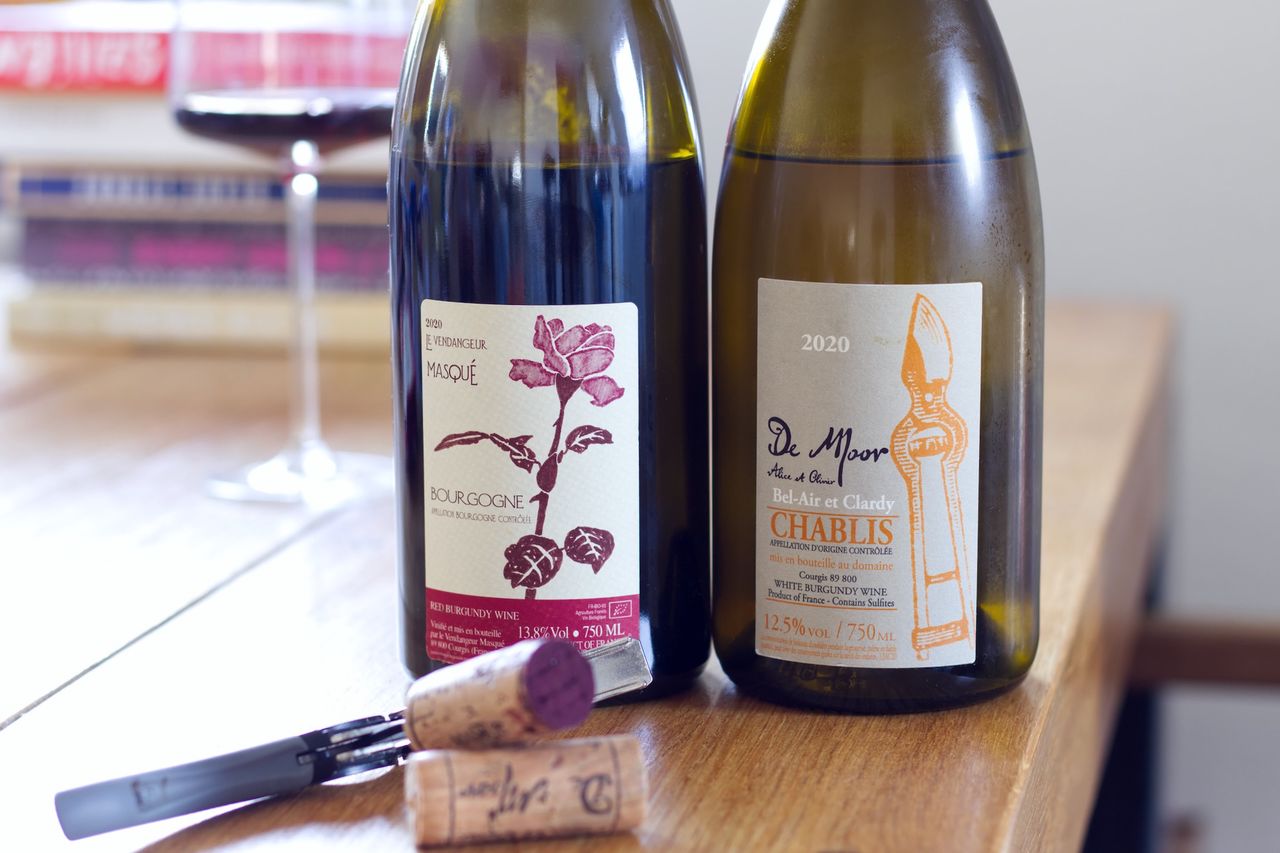
Fear is drinking along. Well, that’s not entirely true, but fear is definitely pulling on the cork too. Because once it’s out of the bottle of De Moor, there’s certainty, but until then, somewhere in the subconscious, the experience with those two bottles of Mont de Milieu is waiting. Of course I know it was just bad luck, that there are plenty of articles and posts from people who had more luck with these exact wines, but I still can’t quite get it out of my head. It’s pretty frightening how a single bad experience can nest itself so deeply in the subconscious. At least so far, not a single subsequent bottle of De Moor has managed to displace it, and we haven’t dared go near Mont de Milieu again at all. At the very least, the buying finger doesn’t twitch quite as much anymore, and since the bottles disappear from the shops mega fast anyway, there’s no need to feel guilty about it.
Chablis, so the northern corner of Burgundy where Alice and Olivier de Moor make their wines, is white-wine country. The fact that we nonetheless have a bottle of red wine on the table is because for a few years now the two of them have also had a négociant line under the name Le Vendangeur Masqué, the masked winemaker, under their wing. The Pinot is still an oddball in the portfolio, and I didn’t find much information. In fact, only for the current 2024 vintage, and since I have no idea whether the grapes even come from the same masked winemaker, we’ll let the details be details in this case. The second bottle, a Chardonnay, contains grapes from the parcels Bel Air and Clardy, is spontaneously fermented, and then aged in used wooden barrels for at least a year.
At first, the Chardonnay comes across as if it still smells of yeast. Unusual after so many years, but not impossible. Two or three swirls in the glass later, there’s nothing left of that. Instead there’s mellow apple, a bit of grain, old apricot, and overall lots of yellow fruit. It’s a bit wild, has something iodine-like about it, and carries that wildness and iodine onto the tongue as well. But then the acidity has so much power that at first there isn’t much else left in the middle of the tongue. Behind that, citrus, very green apples including peel and seeds. Every sip brings more clarity, more drive, and more iodine mineralité. Exciting, not aged at all, and surely caught at a really good moment.
Contrary to my expectation, it gets even clearer on the second evening. There’s puffed, rather nutty grain and still the yellow fruit. The acidity has become tamer, softer, the apple more yellow than green, but still very clearly apple in the way it feels. That’s really impressive. I’m not even allowed to ask myself whether it wouldn’t be smart after all to do a little restocking of the fresh vintages. In any case, this is great Chablis.
The Pinot has beautiful fruit. Very pale raspberry jam, a bit of wood, a bit of Jägermeister. No, actually quite distinctly Jägermeister, plus the spot in the pub near the door to the smoking room. Every time you stick your nose in the glass it’s different. Fascinating. Sometimes the raspberry almost disappears completely, sometimes there’s nothing but raspberry on the nose. And that within maybe 10 minutes. That’s how it actually goes the whole evening with the wine. On the palate there’s lots of freshness, drive, but it can’t quite deliver what it promises on the nose. It feels too cool in the mouth, too distant. But here too, 10 minutes of waiting helps. Red currants, fresh wood, and acerola cherry. And the Pinot also seems younger than the 6 years it has under its belt.
Unlike the Chardonnay, however, the Pinot doesn’t take well to a night in an open bottle. It starts to fall apart the next evening. Not completely, but it’s just no longer what it was the day before. There’s still Jägermeister, and it seems more vegetal, the berries are gone and don’t come back. Maybe a few cherries, a bit of beetroot. The tannin is gentle, the acidity fresh, but something is missing. Now it’s sitting somewhere on the stretch between gentian schnapps and cough syrup, and you don’t really feel like going to collect it there. It sounds worse when you read it than it is, this isn’t a bad wine, but it doesn’t have much to do anymore with the fireworks of fruit and spice on the first evening. Maybe the bark that was very wet when pulled off, maybe simply time now to drink it. Then best in one evening, because then it was simply brilliant.