Two Bottles Naturcidre
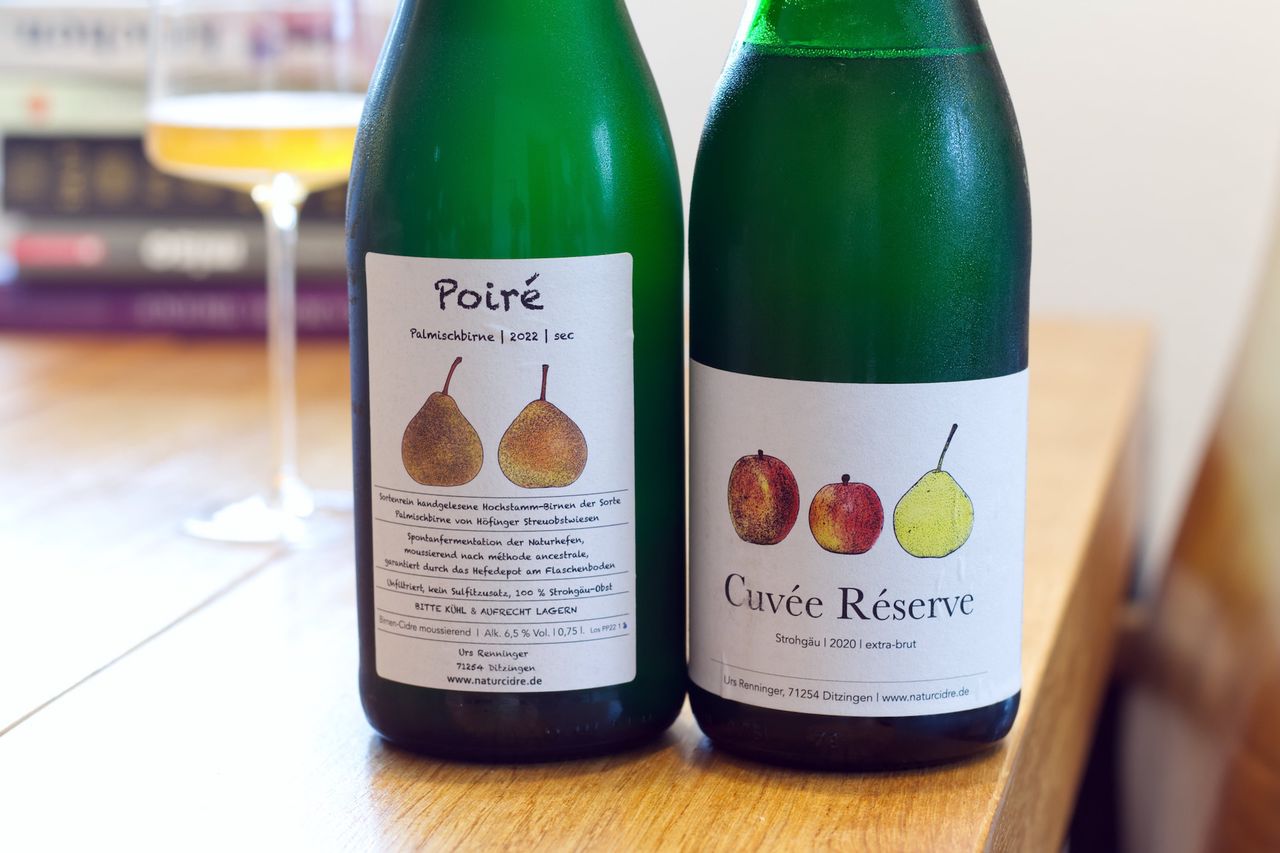
We're drinking fruit fizz again. We're starting with Urs Renninger Naturcidre and a bottle of Palmischbirne Poiré sec 2022 and a Cuvée Réserve extra-brut 2020.
With a year drawing to a close, the Christmas gluttony is about half digested, and stomach acid is slowly settling back to a normal level. “Between the years”, as they like to say. And at the same time: before New Year’s Eve. Inevitably, the next “so what are we actually drinking” question was on the way. And the next bout of excess. For most people, something with bubbles will show up on the list for the turn of the year, alongside the food, for the toast, and in general. That we’re increasingly replacing fermented grapes with fermented orchard fruit in our bottles probably won’t come as a big surprise by now. By now it’s become something of a tradition here to drink beyond the wine in January. Often completely without alcohol, but at least just as often with apple, pear, or quince in the bottles. We’re keeping that going this year too, and for a smooth transition we were starting already last year but with translations lacking behind, here we are. And also because I’m of the opinion that cider or poirée are the better toasting drinks anyway later in the evening. In a way, the repair drink on the night itself. And a second bottle up front or in between isn’t a mistake either.
Urs Renninger now tends around 600 Hochstamm (translation magic says standard) trees in the Strohgäu northeast of Stuttgart for his Naturcidre project. Hochstamm tree means the first tier of branches starts on the trunk at a height of about 160 to 180 cm. Below that there are so-called half-standards and training forms such as bush trees, low-stems, or spindles. Because standard trees are usually grafted onto vigorous rootstocks, the trees get quite large and labor-intensive to manage, since maintenance pruning and harvesting without a ladder, or, in extreme cases, climbing, simply stop being feasible at some point. At the same time, this is the traditional trunk form in meadow orchards, because it also allows the meadow itself to be managed under the tree. And the landscape-defining trees, especially large, old pears, that you picture in your mind’s eye when you think of meadow orchards are standard trees. More than 100 varieties come together in Naturcidre’s holdings, including rarities such as Généreuse de Vitry, which later lend tannin to the cider.
Today we’re drinking a bottle of Palmischbirne Poiré sec, so between 17 and 35 grams of residual sugar per liter, from 2022, and a Cuvée Réserve Extra-Brut, maximum 6 grams residual sugar, from 2020. The Palmisch is, so to speak, educational drinking, because as we already wrote last year, we ourselves planted a Palmischbirne tree in the meadow. A standard tree. It’ll still take quite a while before enough fruit is hanging on it to make must from, but you can already have a little preview. In any case, the Arche passenger seems to have come through its first year on site just fine. The pears in this bottle were, as you can read on the label, if you speak German, spontaneously fermented and then turned into bubbles with a bottle fermentation following the Méthode Ancestrale. It was neither filtered nor sulfured. My own absent-mindedness is to blame for the fact that I can’t write much more about the Cuvée Réserve than what you can see in the picture. Vintage 2020, apples, pears, Extra-Brut. If there was more info on the label, then the glass recycling bin is now smarter than we are. That’s how it goes sometimes.
The Palmisch is extremely taut and starts with a tiny bit of volatile acidity on the nose. There’s pear skin, something pithy, coolness, and lots of freshness. Overall it’s more on the austere side aromatically, and it tastes that way too. Lots of acidity, exactly as much freshness as on the nose, and relatively little tannin behind it. There’s drive here. And when you have it in your mouth, somehow the aroma is reminiscent of sour tongues, not sure if these exist in other countries too, sour candy. The green ones. Of which, as is being claimed directly opposite me, there are supposedly always only very few in the bag, so I’d only get one or two. Sure. Apparently I’m being taken for stupider than I am. The mouthfeel, in any case, is fantastic. It’s taut, then gently foams up and in the process becomes more and more pear, slightly soft, with great fruit. There’s so much drive from acidity and fizz that in the first moments you don’t really notice the residual sugar, and it’s probably slightly different in every bottle anyway. Maybe we also got a relatively dry one. What lingers is honey and freshly cut pear. This is great, and it makes me hope even more that the tree establishes well.
The Réserve has wonderfully beautiful fruit from the very first moment in the glass. It smells like a sack full of gathered fruit. Just without the jute sack. With air, more and more pear comes into the aroma and develops the kind of drive you don’t find that often in apple-only sparklers. There’s a bit of honey and a bit of oxidized apple peel. If anyone is wondering whether sparkling fruit wine survives a few years in bottle: yes, it does. There’s enormous drive on the palate, bone-dry tannin, very straight-ahead, taut, powerful, and intense. Much more linear than you would have thought after the first moments. And here too, drinking changes the aroma, draws it together more, makes it tauter. When you then smell into the glass again after a few minutes, it’s back again, the incredibly beautiful fruit basket. That’s a pretty funny combination: the comfort-scent and the Extra-Brut club that then gets pulled over your head. This would be a candidate for toasting at midnight, or for after a wine tasting. It wakes your tongue back up even after 15 tasted wines. Fresh, not at all pushy, not at all tiring, and somehow just delicious.