Two Bottles Fruitslagers Cul Sec
We are drinking one bottle of Balade Minérale and one bottle of Rouge en Voiture from the alcohol-free sparkling wines of the Cul Sec label by Fruitslagers.
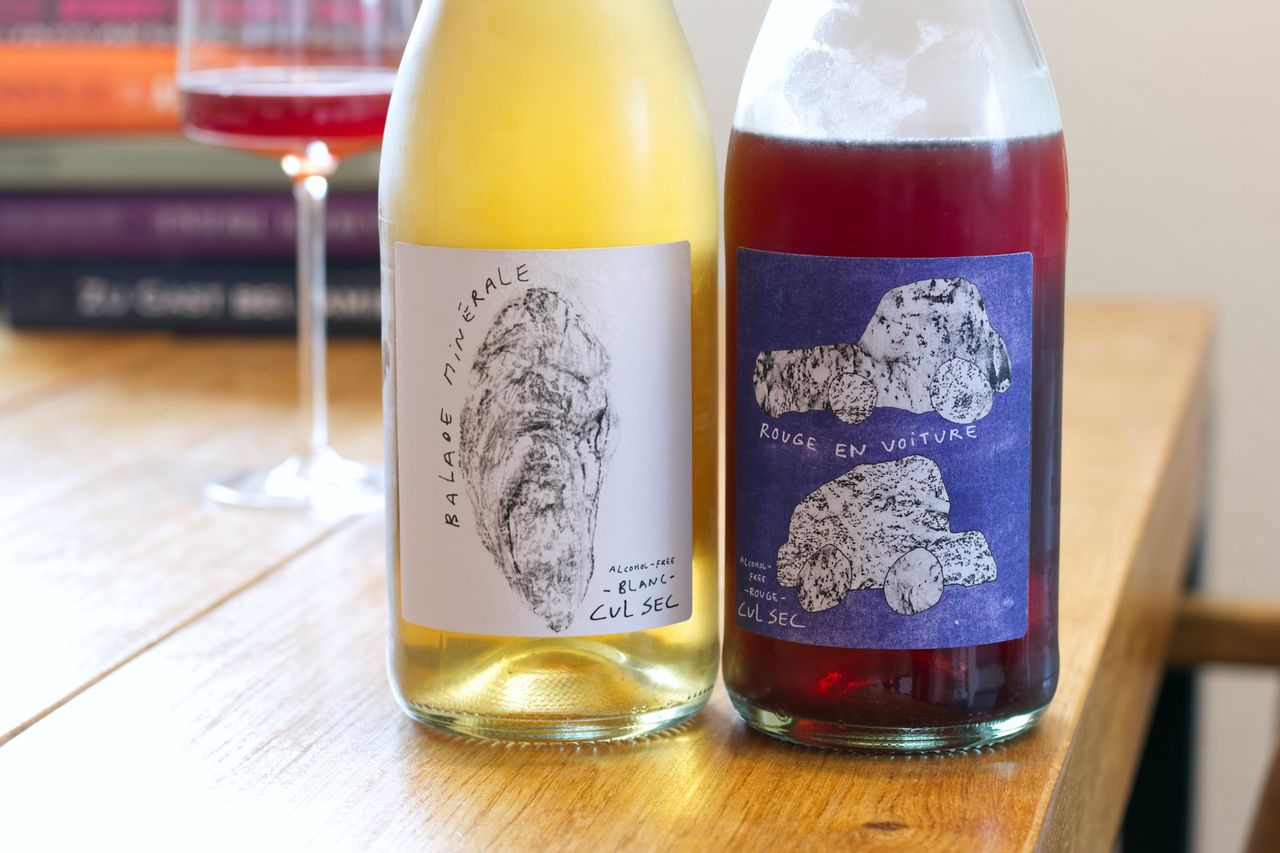
We interrupt the cider programme for an important announcement. Before we more or less fell head over heels in love with fermented orchard fruit, January still had room for non-alcoholic drinks. Not necessarily because we didn’t want to drink alcohol in January, but above all because there’s a lot of exciting stuff happening there too, and especially in January this topic pops up at every turn. No matter how you feel about Dry January, you can’t really deny that having more choice of exciting drinks without alcohol is a good thing. Then at the very least the driver doesn’t have to drink either water or juice while everyone else sips at the wine pairing. And just like with cider and co., this topic is also potentially a whole new field when it comes to origin. The two drinks today come from Fruitslagers in the Netherlands. Cul Sec is their non-alcoholic wine alternative, available in four styles in the current vintage, two of which we’re tasting. However, these two in turn aren’t from the current vintage, more on that later.
First, though, the inner Swabian has to have a quick grumble. I’m sure the fill level of the bottles is meant to be like that. In the marketing photos and on their own homepage they’re filled exactly the same. Or rather, not filled. When I pulled them out of the box, I briefly thought the filling line must have been set too low. Not a good start when you immediately feel cheated out of 2 cm of fill height. But it’s obviously intentional, so all good. Non-alcoholic wine alternatives, or “proxy” as one would say in modern parlance, have completely different approaches. It starts with de-alcoholising an otherwise alcoholic drink, herbal extracts, fermentation, focus, or wild combinations. With Cul Sec they thought “more is more”, and accordingly the lists on the labels are rich.
On the red, that list reads: Sangiovese grape juice, herbal infusion (water, oak wood, pear wood, hibiscus, gentian, rosemary, cocoa), kombucha, water kefir, blackberry juice, rhubarb juice, redcurrant, strawberry juice, smoky peat tincture (glycerine, water, peat), alcohol tincture (water, alcohol, vanilla, blackcurrant leaves, oak wood, Szechuan leaf, cocoa, black pepper). At least on the bottle we had, because the current vintage relies on Pinot and Kékfrankos from Hungary and Dornfelder from Kitzingen, Germany. The grapes come from organic farming by partner producers. And the other ingredients have been tweaked too. Vintage variation in proxy form, then.
“More” also describes what you get on the nose. It smells a bit medicinal, like a very dry amaro and vermouth, lots of herbs, lots of spice. A bit like a Negroni without gin. Sbagliato comes to mind. There’s some wood, more subtle smoke, and behind that cherry sweet and berries. The herbaceous spice also dominates the palate. First comes fruit, then acidity, and then the bitterness moves from back to front across the tongue. The structure and texture are really good. Every subsequent sip first gets briefly a bit sweeter or a bit fruitier and then is caught again by the bitter herbs. This is very strong and right up there from the first sip as far as non-alcoholic alternatives go. It has length and depth, and even the empty glass still smells interesting and not just like sweet fruit juice. Here too there are 40 g of sugar per litre in play, but they’re so well integrated that they hardly stand out. Surprisingly, it works brilliantly as an accompaniment to Kaiserschmarrn with (slightly too sour) plum compote. The fruit becomes fruitier, the bitterness shifts further back. It feels fresher with the Schmarrn and sweeter with the plum. The better half is reminded of sauna and spruce infusion, and since I don’t go to the sauna I just nod along. You can drink it quite calmly over the whole evening. Intriguing. And not as a slightly worse substitute because you have to drive. Rather as its own, independent drink. We’ll buy it again. If only to find out what the new vintage tastes like.
The list on the white sparkling, Balade Minérale, is only marginally shorter: Chardonnay and Pecorino grape juice, water infusion (water, oak, oyster shells), water, water kefir, gooseberry juice, seawater, alcohol tincture (water, alcohol, vine leaves, dulse, Fucus Serratus, lemon verbena, blackcurrant leaves, Douglas fir needles). In the current release, the base will be Müller-Thurgau and Bacchus from Kitzingen.
My first association is briefly vanilla. I have to laugh because of all things vanilla isn’t on the ingredients list. It feels cool and mineral, and in direct comparison to the red, more on the grapey side. When you drink it there’s real drive behind it. The acidity slams, pulls at the cheeks, and is then replaced by structure and salinity. Of course I know oyster shells had contact with what I’m drinking, and if you have that in your head, you might automatically taste it. But in fact we’ve had wines that tasted more like the sea. What may be missing is that slightly iodine note of a real sea breeze. What it shares with the red is that every sip, every smell stays interesting. It doesn’t run out of story so quickly. The acidity is too pointed for me. But, as so often, the other person sees it differently. And opinions really diverge once you shake the bottle. It turns properly cloudy: less fruit, more structure, more texture. Across the table there is lots of love for this. I go back to the red.