Two Bottles Der Kleine Cidre Betrieb
This week there is a bottle of Poiré Sommerberg 2023 and a bottle of Cidre Eulenbaum 2023 from Der Kleine Cidre.Betrieb
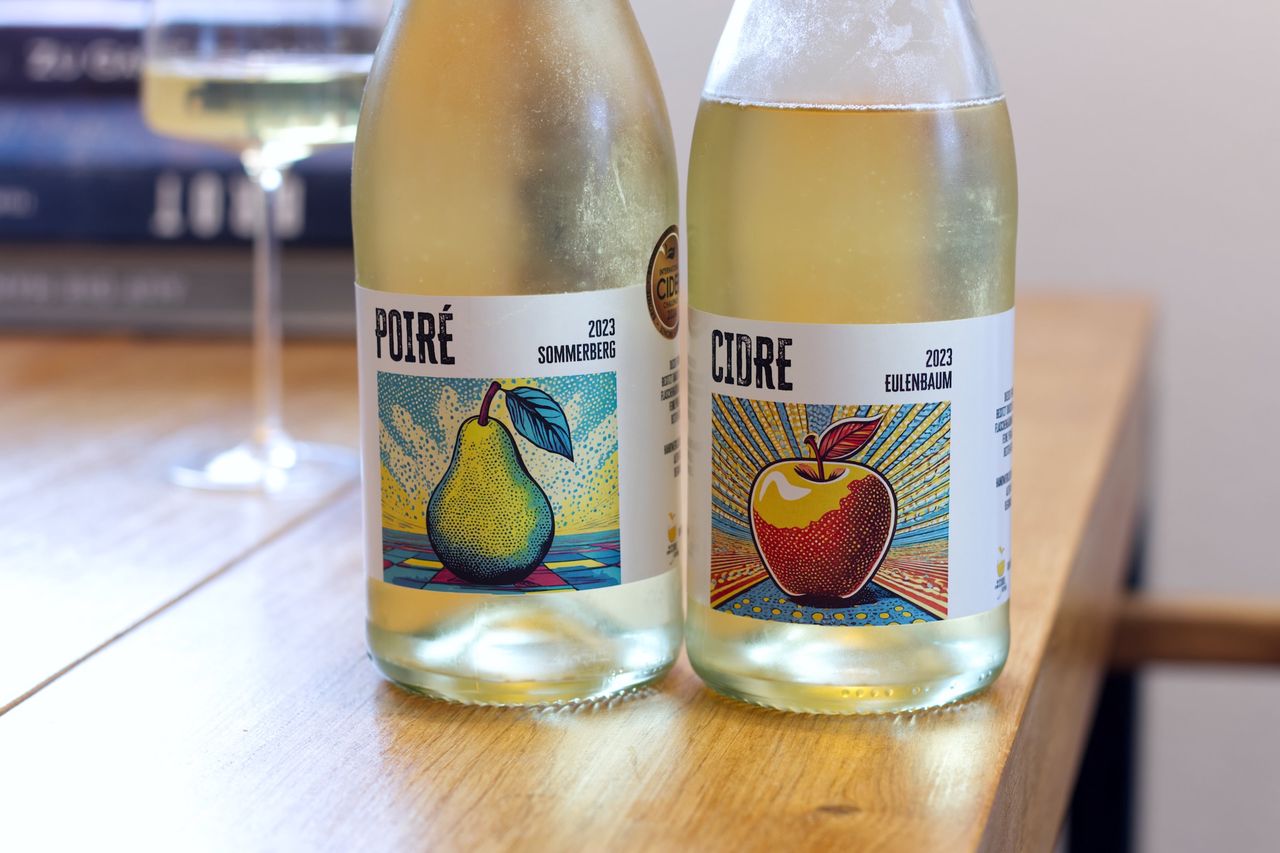
When you drink wine, even if you’re only just getting started, it doesn’t take long before the concept of terroir gets thrown at you. Cider and Poiré are a long way from that. That’s certainly because vines reflect their immediate site much more distinctly than fruit trees ever could. But that’s not actually what I’m getting at. There would be plenty of points of reference for terroir in fermented orchard fruit. Across the entire country, apples and pears are being processed, and no one will deny that, microclimate or no microclimate, the local climate can be quite different. There would be incredibly many very local varieties. Just around the corner here, a few trees of the Schwarze Birne variety are a very good example, which is now also an Arche passenger, and from whose fruit Helmut Dolde makes sparkling wines. Then there’s the influence of the cellar, the training system, the élevage, the maturation. Is that still terroir? Undoubtedly it has a major influence on what ends up in the bottle and is tied to place and producer. Which term you want to pull out for that is secondary. Especially because apple, pear, and quince in this country are still incredibly far from that discussion. Instead of being able to focus on local varieties, in many places awareness first has to be raised again that there’s more than the handful of apple varieties you see in the supermarket. And to plant the trees for them. A pear tree can only laugh wearily at the time a vine needs for its first grapes. But then it might stand in the same place for several hundred years. If you let it. And the drink itself, handcrafted, fermented orchard fruit in bottles, has so far only happened in tiny quantities. That’s certainly one reason why so many of the producers we drink here on the blog are, in one form or another, planting meadows with as many old, perhaps also local varieties as possible. And who knows, maybe that’s the foundation for the idea that in a few decades, people will be able to talk much more about terroir in cider than they do today.
In any case, Volker Nussbaum is doing his part. In Beckum in the Münsterland, in 2021 he lays out a meadow with over a hundred different varieties. Not alone, of course, but with the support of family and friends, because planting trees is pretty exhausting. I speak from experience. The story begins a few years earlier, though. While cycling, Volker was surprised by unharvested public trees along the roadside. I’ll also just point here to Mundraub.org as a possible source for finding public trees in your own neighborhood, too. Or maybe you already know trees with a yellow ribbon around the trunk, indicating that you’re allowed to harvest there publicly in Germany. He then simply started making apple wine from them. And as it goes with hobbies that spiral out of control, he is now a Certified Cider Professional and sells his stuff. The fruit for it comes from unsprayed meadows in the surrounding area, because his own trees will still need quite a while before they can end up in the bottle. Eulenbaum Cidre is pressed from various apple varieties and fermented with cultured yeast. Sommerberg Poiré is made from various pears and fermented spontaneously. Both bottles get their fizz through a second fermentation in the bottle.
Off we go with apple. The Eulenbaum smells hearty, lightly nutty, and of course like apple. But more in the direction of baked apple than fresh apple. Here at the weekly market there’s baked-apple jam, and I feel a bit reminded of that. There are apple skins, slightly browned, and also a touch of vegetal notes. The cider is tart on the palate, with lovely tannin, grip, and structure. There’s freshness at first, which then gives way on the finish to tart honey and caramel. The more sips you take, the more the fruit shifts toward fresh apple. Including the core. On its own, I find the fruit would be even better with more clarity and drive. But with the culinary evergreen here in the household, quiche with smoked salmon, leek, oriental seasoning, generous Alpine cheese, and a chili, it matches incredibly well.
The Poiré has, from the very first moment, what I missed in the apple: focus, tautness, and an extremely clear fruit that, for me, defines Poiré. There’s pear on the nose, of course, a bit of skin, spice, it feels cool and crisp. And that’s exactly how the Sommerberg tastes as well. Lots of crisp acidity, hardly any tannin, and a lovely fruit character. That would also have worked well with food, but it has to do its duty as Sunday-afternoon fizz. There are worse fates for a bottle of pear bubbles. On the back of the tongue, the structure grows with every sip, and at the same time, with air, especially when slurping, the pear becomes more and more pear. That’s really strong. The combination of sweetness, a light bitter note, clear fruit, and that taut acidity is brilliant. All the happier I am when I realize there are still quiche leftovers waiting in the fridge. And yes, that fits very well.
And then I sit there and once again don’t understand why stuff like this doesn’t show up much more often. Not even this one in particular, though of course this one too, but cider and Poiré in general. Fizz is basically always fun anyway, plus the low alcohol, the freshness, and, provided the tannin doesn’t draw your cheeks together, the uncomplicated nature. And then it also goes really well with a lot of food. What more could you want. Hopefully more to come. And who knows, maybe someday someone will be able to ponder and write about whether this is typical Beckum apple terroir. And whether a few hundredweight of flamed Münsterstreifling (or whatever the typical regional varieties are called) would have benefited the cuvée. Because of the bitter compounds or the acidity. Or the more appley fruit. Today is not that day yet. But until then, we’ll take the first step and enjoy the fact that there is more and more of this kind of handcrafted fruit fizz in this country. And that’s something, too.