Two Bottles Böhm Ciderwerkstatt
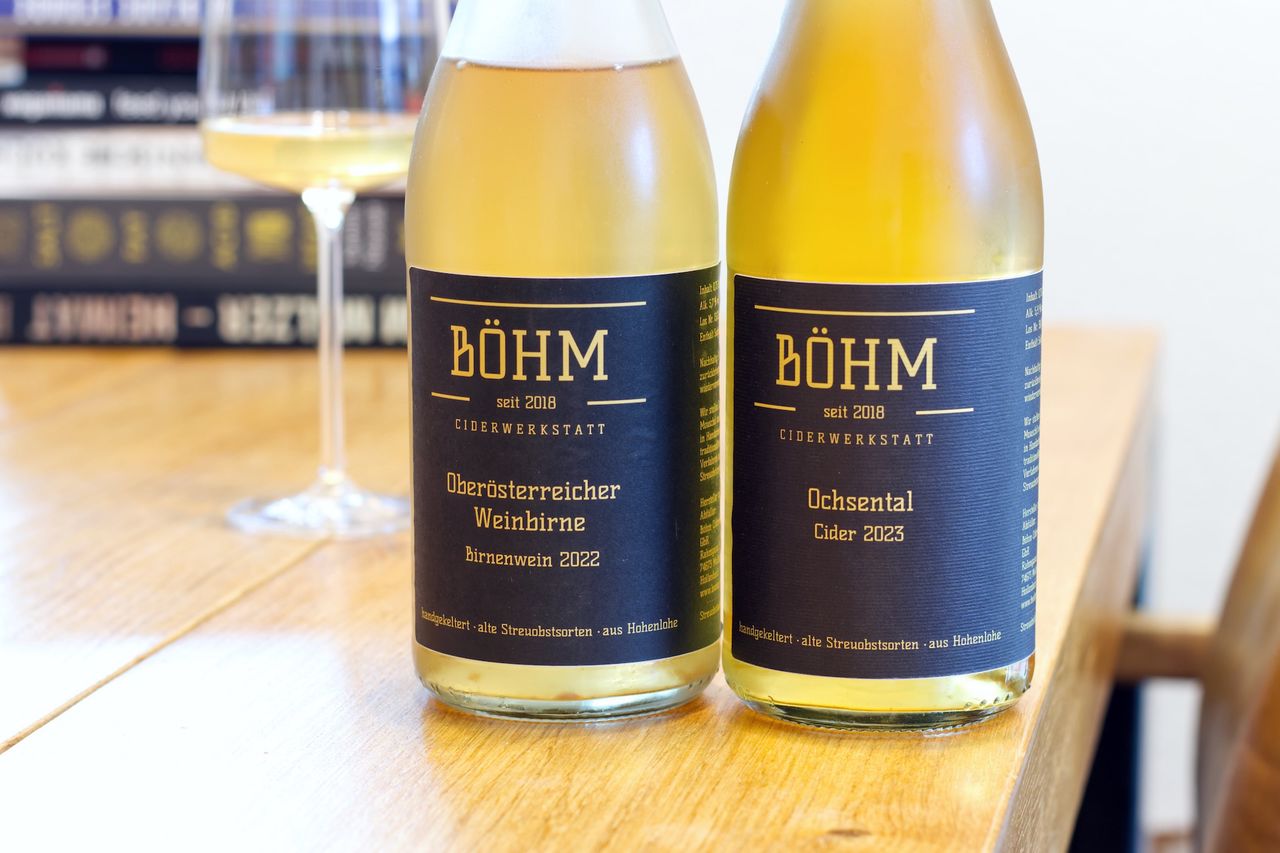
We continue through the world of fermented orchard fruit. We drink from the Böhm Ciderwerkstatt a bottle of Ochsental Cider 2023 and an Upper Austrian Weinbirne from 2022.
Pop. Pop. Ah, swing-top bottles. For all the debate about tree bark, agglomerated corks, screw caps, crown caps, glass stoppers and all sorts of plastic in the bottle neck, for all the joy traditionalists take in pulling a cork, all the pain at the smell of wet cardboard and the feeling of security when unscrewing. If there’s a swing-top bottle standing anywhere nearby, then my two thumbs are on the clasp faster than anyone can shout “agraffe”. Pop. And nobody, really nobody can tell me that isn’t awesome. The more pop, the better, really. And at least in my circle I’m not alone, here in the household I’m usually too slow at the bottle. A bit of international consensus that the young year can, unfortunately, already urgently use. A pity that in the wine world this type of closure plays absolutely no role at all. The only one that comes to mind right away is the petnaT 3000 from Weingut Schätzel. But right now we’re not drinking wine, we’re drinking fermented orchard fruit, and at the Ciderwerkstatt Böhm they bottle under pop. Hooray!
Three generations of the Böhm family have been working since 2018 in Mulfingen-Hollenbach in Hohenlohe in their cider workshop. One of the benefits of drinking apple, pear and quince for a few weeks a year is certainly that you get to know even more places you’d never heard of before. The trees from which the two bottles were pressed stand on old orchards around Hollenbach. In 2017, Manfred Böhm acquired an old property in whose natural-stone cellar the must has since been allowed to ferment and mature. What started with 50 liters is, if you look at the latest Insta posts, by now a nearly bursting cellar full of vessels. There was just a lot of fruit in this, ah no wait, by now, yes, last year. Like all other small producers, the Böhms too care deeply about the traditional orchards and their preservation. The beehives they now also have of course help with that. We’re drinking two bottles today, though not the ones I had planned. The plan was one Rot, which is red in German, but in this case cider from the meadows around the village of Rot, not the color, because that one would have been dry. But I only noticed that after the bottle had already been drunk. And so today we’re drinking a pear wine, practically without fizz, from the variety Oberösterreicher Weinbirne from the year 2022 in off-dry. And an Ochsentalcider, with fizz, from 2023. That contains, among other things, the varieties Gewürzluike, Öhringer Blutstreifling, Brettacher, Goldparmäne, which is King of the Pippins in English, which I read somewhere and like so much as a name so I can remember, and Kaiser Wilhelm.
We start with the pear. Clear, ripe and quite sweet in the fruit. There’s some honey, a bit of creaminess and a few core housings. Intense and actually pretty sweet on the nose. On the palate, the fruit comes first and then honey, lots of honey, that stays on the tongue for a very long time. That’s not necessarily what we otherwise drink from pears. Lots of sweetness, no fizz. But when you have it in your mouth, you wonder why, actually. There’s definitely freshness behind the honey, and when you slurp, there’s also tannin. I like that. Maybe only for a glass, I don’t know yet, but I like it. And with dessert, or rather as dessert, that should work really well. And the second glass is also a joy.
The creaminess on the nose had turned into a massive amount of butter toffee on the second evening. And this mix of butter toffee and pear is really, really good. The taste is unchanged, but you can’t get your nose out of the glass anymore.
The cider has clearly more drive on the nose. A topsy-turvy world, when it’s usually the perry that makes us pull faces. That’s certainly also due to the carbonation present here. But it also feels more pithy, not so fruity. There’s green apple, a bit of peel and really a lot of pull. There’s more acidity or correspondingly less sugar. There’s sweetness too, it balances, flatters, a bit of old hay, a touch of stable, a bit of core housing and forest honey. The longer the cidre sits on the tongue, the sweeter it feels. My only quibble. The first glass disappears virtually immediately, the second much more slowly. The sweetness somehow makes you feel full but that might be our current taste. We can count the non-zero-dosage sparklers in the year, or at least non-Extra-Brut representatives, we drink on very few fingers. Maybe that too is just a phase and at some point we’ll drink with more residual sugar again there too. The balance, in any case, is really lovely: a bit wild, a bit pithy, sour, sweet, appley.
The bottle survives a night in the fridge, foaming and all, nice and easy. Closing it again is no problem, after all. For a moment I even have the feeling that the pop makes a bit more pop on the second day. But that may be imagination, because any significant refermentation overnight at refrigerator temperatures is rather unlikely. And it hasn’t lost any balance either. Very tasty. Even for Brut Nature drinkers.