Two Bottles Julia Bertram
We are drinking two bottles from Julia Bertram from the Ahr: A Frühburgunder 2017 from the Neuenahrer Sonnenberg and a Spätburgunder 2018 from the Ahrweiler Forstberg.
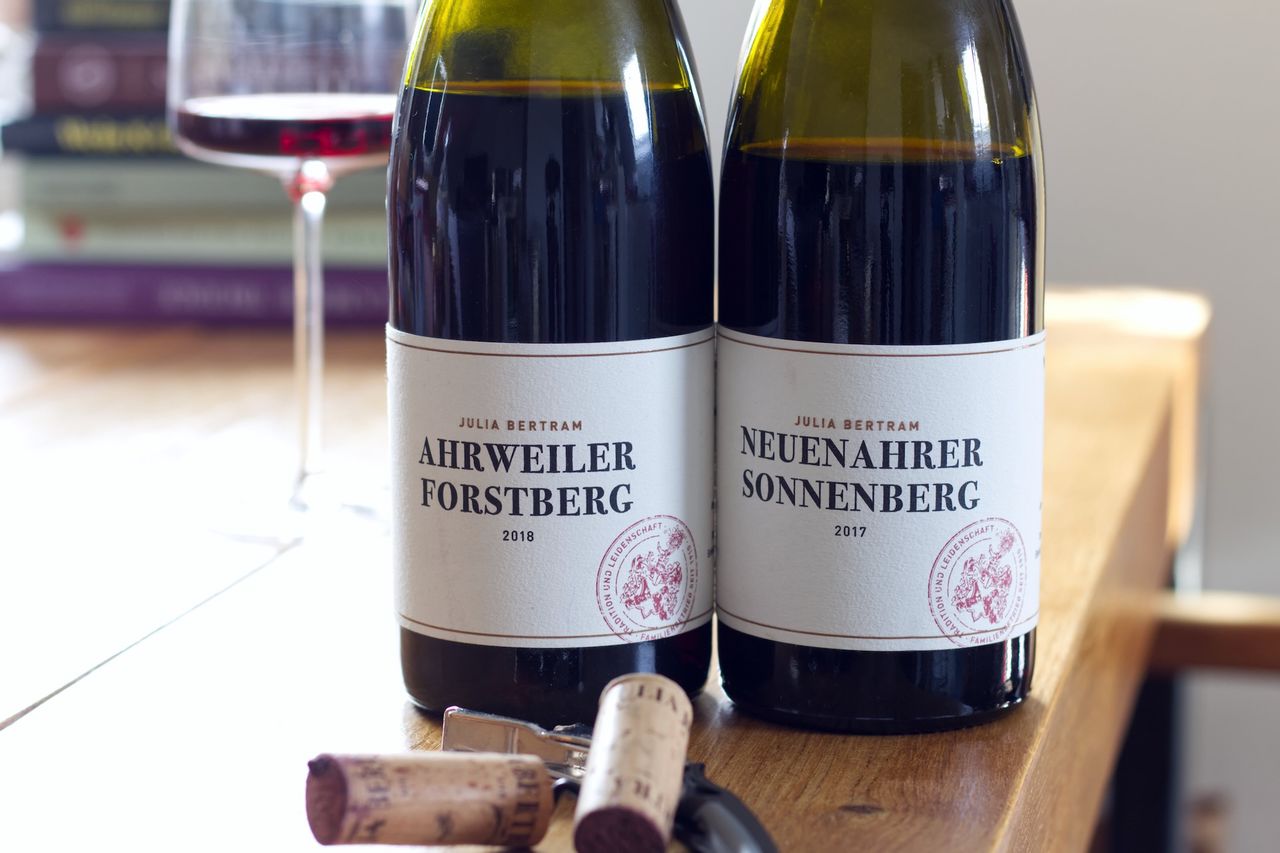
Admittedly, it doesn’t feel fair to the Ahr that the last bottles from the region were from the exact same winery and that the article started with the words that there’s a need to catch up on this wine region. That obviously didn’t work out so well. I promise right at the beginning: It won’t stay this way and soon other Ahr wines besides those from Julia Bertram will appear here. But not today. Because today we are drinking Julia Bertram again, who in the meantime is no longer called Bertram, but Baltes, and still grows and vinifies mainly Spätburgunder in the Ahr region at the Bertram-Baltes winery.
Back then I had ordered a case cutting across the vineyards and over the years I’ve pulled a bottle every now and then. And although I really liked the wines every time, I could never shake the feeling that I might be opening them too early. Part of opening the bottle was always the mental preparation for the reduction that immediately jumps at you. This is always followed by two reflexes. First, lots of air. And second, the thought that it will surely age out. But whether this is actually the case has so far been more theory than practice. The question in general is also immensely exciting, because the Bertram-Baltes of this world are not the only ones where it comes right at you out of the glass. Yes, Huber, I’m also looking in the direction of Baden. In any case, the last two bottles from the case will hopefully help in the learning process. But we’re not just drinking Spätburgunder today, we’re starting with a Frühburgunder from the Neuenahrer Sonnenberg from 2017. In addition, there is a bottle of Spätburgunder 2018 from the Ahrweiler Forstberg. What sounds like two different places is in reality quite close together. The town is called Bad Neuenahr-Ahrweiler and so both vineyards, with the A573 in between, are located north of the town with a view south towards the Ahr.
We start with the Frühburgunder and, in fact, it doesn’t jump at you. Yes, there is still a slight reductive funk in the glass, but somehow it would be terribly boring without it and I actually like it, but the balance is much more pronounced. There is a beautiful red fruit, bright berries, cherries and some spice. It drinks super clean, then comes acidity and then the structure grips the back of the tongue. It’s not scratchy, but there is still a decent amount of tannin in the wine. And when you then rinse the Frühburgunder around your mouth, that little bit of funk disappears completely on the nose. It is now a beautiful combination of almost sweet fruit and a herbaceous, slightly ethereal spice with some licorice. This is lovely. Very lovely.
On the second evening, it becomes even softer on the nose. The ethereal notes increase, coming at you first, before the fruit follows, which seems a bit darker than on the first evening. Aromatic, dry wood and herbs. The tannic grip has melted away, instead it is reminiscent of cherry juice, with lots of freshness and a bit of an easy-drinking quality. Not what I had on my bingo card for this wine. I wouldn’t hesitate for a second to stick a “Best Frühburgunder I’ve ever had” sticker on the bottle. However, I have also had significantly less than a handful of single-varietal Frühburgunder so far. But still, this is really strong and any subsequent Frühburgunder will have to try extremely hard to even come close.
The Spätburgunder from the Forstberg is much darker. There is a bit of blood, the fruit is rather dark and it already smells softer and somehow more voluminous. When drinking, it has the same clarity, but here too the fruit is more dark cherry than bright berry. And the tannin is also much softer in comparison, in fact you feel almost no grip at all. What is astonishing is that the wine nevertheless feels denser, lingers longer and has no less power. There is a slightly wild earthiness on the nose that gives the wine an incredible amount of tension. Perhaps this is even more apparent when the wines are side by side. The Spätburgunder drinks just as well as the Frühburgunder and if it didn’t linger on the tongue forever, the bottle would be empty quickly. It’s not better than the Frühburgunder, not worse, it’s just different.
The spice completely takes over on the second evening. The blood has diminished, it now has something of a stew with dry, Mediterranean herbs and sandalwood. And then comes the acidity, which grips the tongue unchanged. Where the Frühburgunder drifts towards a comfort wine on the second evening, this one continues to pull the wrinkles from your brow. There aren’t many of those anyway, because you don’t have to ponder whether you should have waited longer when you have the wines in front of you on the table now. Both bottles are fun and, just like on the first evening, I don’t want to have to choose between them. But the decision to give the wines a few years was worth its weight in gold.